
Managing Non-Profit Organizations.
But what happened during the recording could be taught under a completely different title:
In a season that decided to have a grand title: "The Sector's Tale", this episode came with a title no less ambitious:
"Digression as a Way of Life… and a Systematic Destruction of the Agenda".
The episode transformed from an attempt to open a file on management to a long session of 'test mic' and reconciling with criticism, a free tour around grants, strategies, donors, data, fellowships, travel experiences… then recalled late that the original title was about Managing Organizations, not an Account of the Struggles with the Mic and Mac.
The sector that demands management needs to start with managing its dialogue sessions first.
This is a critique that does not undermine the value of the presenters or their expertise – quite the opposite – but it gently tries to say (with a bit of loving sarcasm):
First: 12 Minutes of Voice Management… Without a Word about Management
They then enter into an absurdly amusing interlude about the camera, the shemagh, the new phone, and the mic that "has an issue today", along with jokes in English and Arabic, before the listener hears any sentence that resembles the topic of the episode.
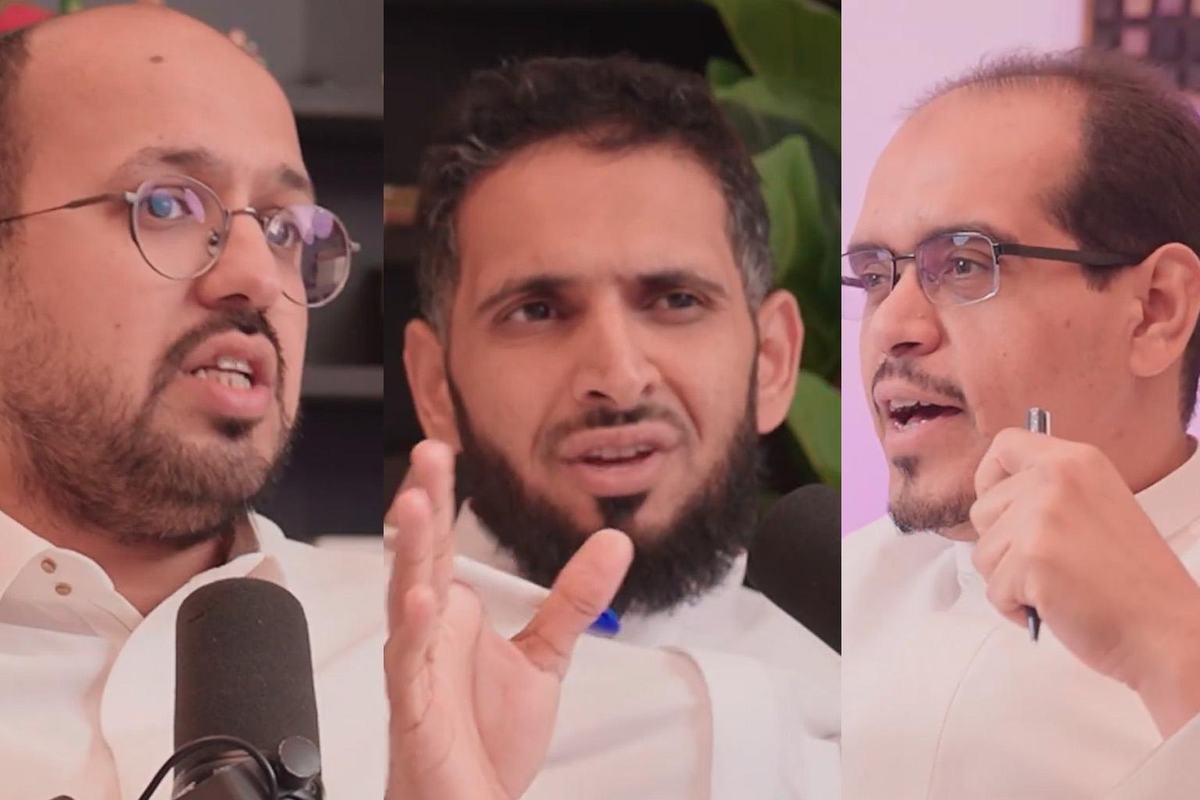
The trio of Hamid Al-Dhiyabi, Mohammed Al-Mutairi, and Hilal Al-Qurashi opens the episode with a continuous series of: "Test mic test mic",
this improvised/homey charm works – once, twice – but here it turns into a living example of the same problem:
- There is no proper introduction to bring the listener back to the title.
- The listener is not simply told: "Today we will talk about: Who manages the organization? How is it managed? For whom is it managed?" until almost the end of the episode, when the phrase "Mikl / Mike" appears as a late attempt to rescue the chaos.
In an episode about "management", it was expected that we would see at least:
- Time management: cutting the chaos of the test and technical jokes before publishing.
- Managing the listener’s expectations: introducing the topic within the first 3 minutes, not after 30.
Spontaneity is beautiful, but when it surpasses a quarter of an hour before entering the subject, it transforms from an asset into a condemnation of the episode's title itself.
Second: What was Actually Said? Strengths that Deserve Not to Be Lost Amid the Digressions
Justice requires acknowledgment: behind this narrative chaos, there are deep and serious ideas that, if compiled in a well-structured episode, would have resulted in one of the season's most important episodes. Among these points:
1. Criticism of the "Balanced Scorecard" as a Replicated Tool
Mohammed opens fire – deserving to be invested – on:
- the use of the balanced scorecard originated in the context of factories,
- then replicated in small charitable organizations,
- without real adaptation to the nature of developmental and social work.
He reminds us that administrative literature itself has begun to question the suitability of this tool in many contexts, while the non-profit sector here still treats it as if "bear witness that we have strategies".
Change theory and the logical framework and developmental thinking methodologies, despite their difficulty, but:
In contrast, Hamid proposes a more mature alternative:
- Closer to the core: Why do we exist?
- And closer to the real question: What impact do we want to measure, not just the number of activities?
2. 80% of Associations… Emerging: A Sector in Its Early Stages
Before 2015, associations were much fewer, today we are talking about nearly 7000 organizations, and it is estimated that about 80% of them are emerging associations.
Hamid presents a pivotal figure:
This sentence alone deserved to be built upon for a whole episode about:
- What it means to be an 'emerging' association rather than a 'stable' one.
- And how the tools for planning and governance should differ between emerging and established ones.
But it appears as a fleeting statement amid the flood of digressions, rather than being a constructive focus of the episode.
3. False Accountability in Grants: A Release Paper, Not a Learning Paper
Hilal - as usual interrupting with the annoying marketing jargon of the third bank - links this to what was published in the third bank about "False Accountability in Grants" and how:
- Some donors' requirements turn into bureaucratic layers whose main goal is to protect the funding institution,
- more than aiming for shared learning with the organization and developing impact.
He tells the story of the third bank itself as a counterexample:
In contrast to projects that started with all the paperwork, only to end up as 'strategy in the drawer'.
A project that began without a vision, mission, and written goals, yet achieved success and clear impact,
Paper does not manage organizations, but justifies decisions after they occur.
The idea here is dangerous:
4. A Call to "Monshaat" for the Non-Profit Sector
One of the smartest proposals in the episode:
But designated for the non-profit sector:
The call to establish a body similar to "Monshaat" for entrepreneurs,
- Supports emerging associations,
- Simplifies the establishment steps,
- Provides unified content and guidance,
- And offers a common incubator instead of scattering efforts across disjointed initiatives at the donors.
This idea, if presented within a clear framework, would have been a mature political/developmental message addressed to policymakers.
5. The Battle of Data and Privacy
Hamid points to a painful wound:
- The sector lacks a unified data system for beneficiaries and impact.
- There is repetition in providing services to the same individuals, as associations do not see each other.
- And some associations still publish reports that contain the names of beneficiaries and their civil numbers in a blatant violation of their privacy.
He connects all this with the idea:
"There is no non-profit sector without data"
And this phrase would make a fitting title for a national project, but it passed – as usual – unnoticed amid the wave of jokes and stories.
Third: Where did Management Go Wrong in the Management Episode?
Rather in Managing these Ideas within the available time and the announced title.
The problem of the episode is not in the quality of ideas;
1. The title is one thing… and the course of discussion is another
The actual content:
The title: Managing Non-Profit Organizations
- 15–20 minutes of "confession" with the audience about criticism, praise, and fellowships.
A profound discussion – but unframed – about:
- Donor plans,
- Program failures,
- Strategies and scorecards,
- Paper governance,
- Startup mindset,
- Data and privacy,
- Large associations and their financial sustainability,
- Personal experiences in travel and fellowships.
But gathering them this way within the title of "Managing organizations" made the episode feel like:
Each of these topics deserves an independent episode;
"The Sector's Tale from Above the Cloud" not from the Executive Director's Office.
"I am a manager of a small association… what should I do tomorrow?"
Will not find a short practical answer, but will leave with a larger bag of questions.
The listener who wants an answer to a simple question:
2. The "Mikl" Model: A Smart Framework That Came Late
In the last third or so, Hilal presents a nice framework:
- M Who manages the organization?
- K How is it managed?
- L For whom is it managed?
This is exactly what should have been said in the fifth minute of the episode, not in the minute after ninety.
The framework is smart, usable in training and consulting, and could have:
- Divided the episode into three sections accordingly.
- Linked each digression (donors, strategies, data…) to one of the letters of "Mikl".
- Referred back to it in the conclusion.
The framework was used as a late attempt to "piece together the scattered parts of the episode" at the end, instead of being a guiding thread from the beginning.
But what happened was the opposite:
3. Lack of Practical Level: Where is the "Manager of Today"?
Despite the density of conversation about:
- Donors,
- Governance,
- Data,
- Large associations,
- Global experiences…
What was almost completely missing was:
- A description of one working day for an association manager.
Practical examples from successful or failed models in internal management:
- How are meetings managed?
- How are work teams built?
- What is the role of the board compared to the executive management?
- What does it mean for an association to be 'stable' or 'overly bloated' in management?
The episode remained in the realm of "policies and systems" more than it came down to the ground of "daily practices".
Fourth: What Do We Learn Editorially for Upcoming Episodes?
To avoid turning criticism into self-flagellation, this episode can be turned into a learning lab for the Sector's Tale podcast and other content in the sector:
1. A Moment of Technical Silence… Before Publishing
- Every "test mic" and "mic has an issue" should belong before the recording button or after it, not in the listener's ear.
- Editorial cutting is not a betrayal of spontaneity; rather, it is the highest degree of respect for the audience’s time.
2. A Solid Introduction Not Exceeding 3–5 Minutes
In episodes with heavy titles (management, governance, sustainability…), it is preferable to always start the episode with:
- A clear central question.
- The main topics/framework (like "Mikl").
- A quick connection to the Saudi reality (the national center, the number of associations…).
Then, spontaneity can be allowed, but from "inside" the topic, not outside it.
3. A Fixed Segment: "The Manager's Toolbox"
A practical proposal for the podcast:
"The Manager of Today’s Toolbox"
In each administratively themed episode, dedicate 10 minutes in the last third titled
- 3 things the manager should start doing immediately.
- 3 things to stop doing immediately.
This ensures that no matter how much you drift in the intellectual sky, you will leave in the end with something to apply on Sunday in your office.
4. Investing Heavy Ideas into Other Products
The current episode is full of seeds that could transform into:
Articles in the third bank:
- False accountability in grants,
- Emerging associations and governance pathways,
- Critique of the balanced scorecard,
- Beneficiary data and privacy.
- Short guides or work papers built on the "Mikl" model and presented to association leaders.
What was said in the episode is too valuable to be left confined to an audio digression.
Finally: From the Dysfunctional Mic to the Dysfunctional Management
The episode – as chaotic as it is – presents a very honest picture of the state of a large part of the sector:
- Good intentions.
- Deep accumulated experiences.
- Big and brave questions about donors, governance, and data.
- But… Little management for structure, time, focus.
In this sense, the episode can be seen as a miniature model of the sector itself:
We have much to say, but we are still learning how to manage the way we say it.
And when The Sector's Tale returns with a second episode about management, it would be nice to see "Mikl" leading the way from the first minute… not waiting until the end of the episode to be called upon as a late traffic officer.
Perhaps the best "management" of this episode is to read it as a self-learning text for those who recorded it before it is re-heard by the audience.

Comments (3)
No comments yet. Be the first to comment!