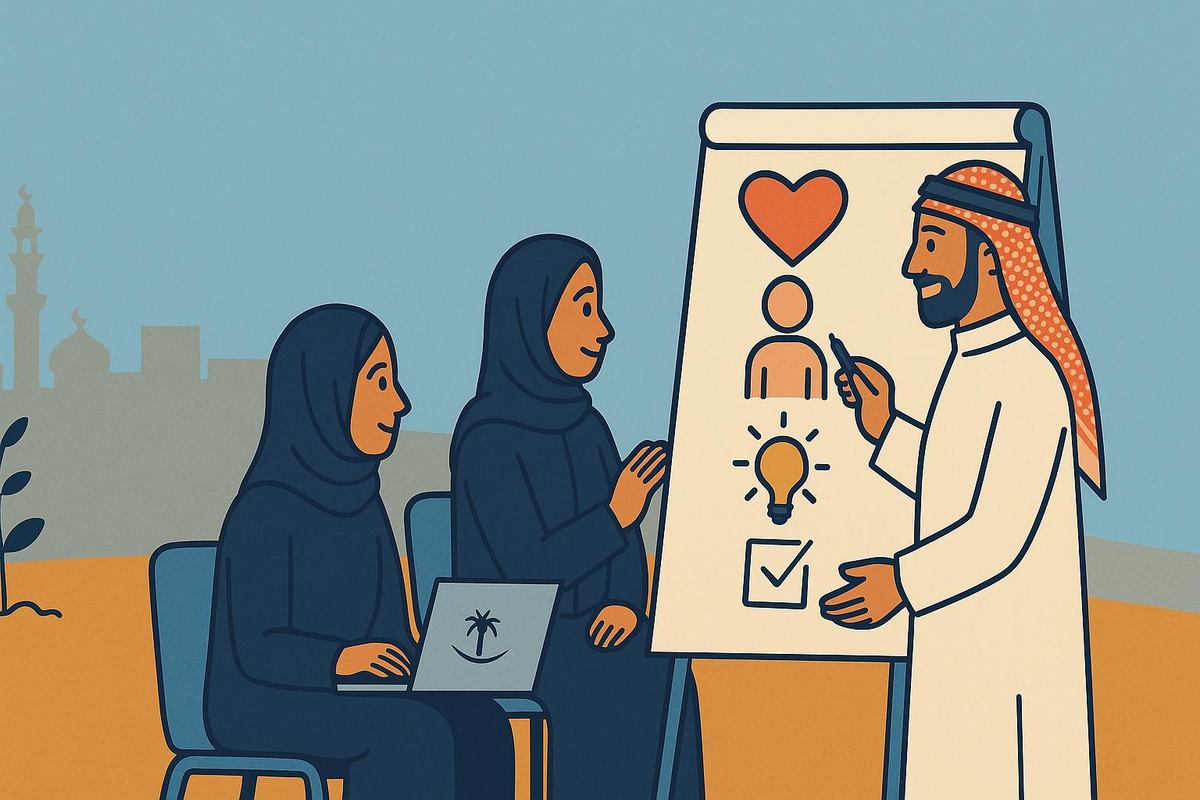

In an age where technology accelerates and public expectations change, it is no longer sufficient to offer merely good services; we need to provide services that reflect the real needs of beneficiaries and create a sense of appreciation and satisfaction. This is where design thinking plays a role as a methodology that places human beings at the heart of every solution, transforming data into a simultaneous emotional and practical experience.
What is Design Thinking?
Design thinking is an approach to solving complex problems in a way that focuses on humans first, based on empathizing with beneficiaries, understanding their problems deeply, and experimenting with solutions collaboratively.
It consists of five interconnected stages:
- Empathize: Explore the feelings and experiences of the beneficiary.
- Define: Formulate the real problem from the beneficiary's perspective.
- Ideate: Unleash a variety of solutions.
- Prototype: Build prototypes quickly and at low cost.
- Test: Test solutions with beneficiaries and improve them based on their feedback.
Why does the nonprofit sector need it?
Because design thinking does not provide ready-made solutions; it builds them from within the beneficiary community. This radically changes the way programs are developed, digital platforms are designed, and the donation experience or service acquisition is improved.
In a sector like the nonprofit sector in Saudi Arabia, where there are diverse groups of beneficiaries and supporters, this approach becomes an effective tool for:
- Enhancing the donor experience in online stores.
- Developing digital services that consider individuals with disabilities or limited tech skills.
- Building community initiatives in partnership with the target audience.
Practical Example: An Online Store for a Charity
Imagine a charity working in orphan care that manages an online store for collecting donations.
The Problem: Donation completion rates are low despite high visits.
How do we apply design thinking?
- Empathy: Interviews with visitors who did not donate. What did they feel? Why were they hesitant?
- Define: "The donor does not feel confident that their donation will have an impact, and they seek an immediate feeling of satisfaction."
- Ideation: What if we provided a short video illustrating the impact? Or an option to designate the donation to a specific child?
- Prototype: A simple page with a mini donation experience + a visual thank you message.
- Test: Launching A/B Testing to measure the impact of improvements.
The Result?
A 22% increase in the completion of the donation process during the first week of testing.
How can your organization start applying it?
- Start with empathy: Organize open listening sessions with beneficiaries or donors.
- Invest in tools like Journey Map and Interview Cards (available from Stanford d.school).
- Build simple prototypes: Don’t wait for perfection, test quickly.
- Record realistic feedback: Use the "I Like / I Wish / What If" model to analyze feedback.
- Iterate, and don’t fear early failure.
Design starts from listening, not from action
In charitable work, it is not enough to improve intentions or gather resources. We need to listen deeply, reflect on the experience from the beneficiary's perspective, and then innovate with them, not on their behalf.
Design thinking is not a luxury; it is a path to creating more human, impactful, and sustainable solutions.
Resources:
- Stanford d.school Bootleg Deck
- IDEO.org – Human-Centered Design
- Harvard Business Review – Design Thinking Comes of Age

Comments (2)
No comments yet. Be the first to comment!