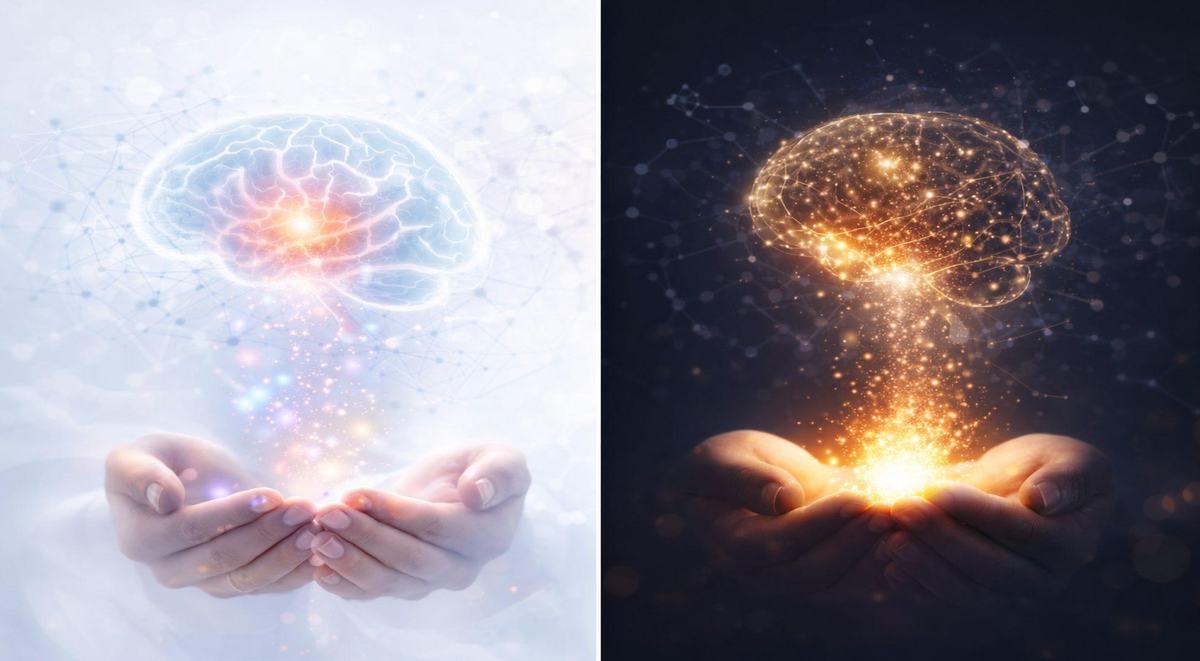

Understanding giving is no longer just a financial matter; it has become a scientific entry point to understand humanity itself. This article provides a recent analytical reading based on neuroscience and behavioral research, revealing how the decision to donate is formed in the brain, and why it is more associated with identity, trust, and meaning than with numbers. We present this translation in “the third bank” while preserving the literary rights of its author and original source, as a cognitive resource to help nonprofit organizations redesign their relationship with donors with a deeper awareness.
For decades, giving has been talked about as if it were a purely financial decision; a rational action taken after a careful weighing of budgets, needs, and priorities. However, delving into the neuroscience related to generosity has uncovered a very different reality: giving is not a financial transaction, but a biological event.
If we understood this meaning more deeply, fundraising methods would radically change, and the experience of the donors themselves would also change significantly.
After years of interdisciplinary research between neuroscience, behavioral economics, and psychology, the findings were not just interesting theoretical ideas, but practical and applicable processes that could bring about a real transformation in how nonprofit organizations inspire generosity in a world that is increasingly fragmented and where trust is waning.
Here are three principles that reshaped my view of fundraising.
1. Giving activates the identity network… not the purchasing network
One of the most impactful studies that changed my understanding of philanthropy came from researchers Jorge Moll and Jordan Grafman at the National Institutes of Health. Their research, using functional magnetic resonance imaging (fMRI), showed that when people donate to causes that truly matter to them, they activate the mesolimbic reward system in the brain, along with areas related to identity, meaning, and social connection.
In other words, giving seems to be more like self-expression than mere financial expenditure. This explains why donors often express themselves with phrases like:
“This reflects who I am.”
“This is important for my family.”
“This aligns with my values.”
These expressions are not just metaphorical or emotional; they are neurologically accurate.
The brain asks a completely different question: “What does this say about me?”
Traditional fundraising asks: “How much will this cost?”
A donor making a gift in honor of a parent with Alzheimer’s is not only supporting scientific research, but is simultaneously enhancing his identity as a caregiver, a child, or a person who preserves memory and loyalty.
When fundraising professionals succeed in addressing these identity circles, giving naturally grows and takes on deep meaning.
2. “Generosity decay” happens quickly… sometimes within minutes
Behavioral studies, including research by Dr. Katy Milkman, have shown how quickly motivation fades after an initial emotional spark. I call this decline “generosity decay,” which is one of the most underestimated factors in philanthropy.
We know this feeling instinctively: you are moved by a human story or an urgent crisis, you intend to donate, and then phone notifications pop up, or your child calls you from the next room, or a new email lands in your inbox.
That spark dwindles not because you no longer care, but because the friction and daily noise have stolen the motivation before it can turn into action, and the same happens with donors. That’s why designing systems is not just an operational task but a neural strategy to protect positive human behavior.
Every delay in asking for a donation, every unnecessary additional click, every late thank-you message, every unclear step… adds a neural burden that slows the decision even though generosity is already present because our mission is not to create it, but to protect it from decay.
3. Trust is a powerful neural shortcut… and we undermine it more than we realize
Research by Paul Zak on oxytocin shows that trust is not a vague feeling but a measurable neurochemical state that increases empathy and positive social behavior. When trust is high, people donate more and at a higher rate.
However, trust decays in small and often invisible ways:
1. A delayed thank-you message.
2. An unfulfilled follow-up promise.
3. Confusing or unclear financial information.
These are not just administrative blunders; they are triggers that activate the amygdala, the center of caution and threat detection in the brain. When that happens, generosity stops.
One healthcare organization I worked with started sending immediate thank-you messages on the same day, followed by personal video clips of no more than 20 seconds, recorded via phone. Donors were not impressed by the production quality; they were affected by the speed of response, and trust increased because rapid interaction sends a clear signal of reliability.
2. Can I trust you?
1. Can I feel safe here?
The brain always asks two fundamental questions:
When donors feel seen and appreciated, oxytocin levels rise… and so does giving.
The future of fundraising is already present, but we don’t fully understand it yet
Many nonprofit leaders feel a shift in donor behavior but can’t adequately name it. From my perspective, donors have not changed as much as our understanding of how their brains work has changed.
Identity, trust, meaning, memory, and motivation all chart a roadmap before us that was not available before, and we no longer need to guess nor rely solely on intuition.
We are now seeing the deep structure of generosity more clearly:
We can design fundraising strategies that align with human brain nature, instead of working against it.
All we need to do is respect the way it works.
It is powerful, human, and beautiful in its essence.
Because generosity is not fragile.
This argument reveals that building sustainable generosity does not start with crafting the request, but with respecting the donor's full human experience. When nonprofits understand how the brain works, they become better able to protect motivation, enhance trust, and transform giving from a fleeting response to a long-term relationship. What is presented here is a guide that is adaptable, opening the door to a deeper professional endeavor in designing fundraising based on balanced scientific and human principles.
The article is translated with modifications from nonprofitpro

Comments (4)
No comments yet. Be the first to comment!