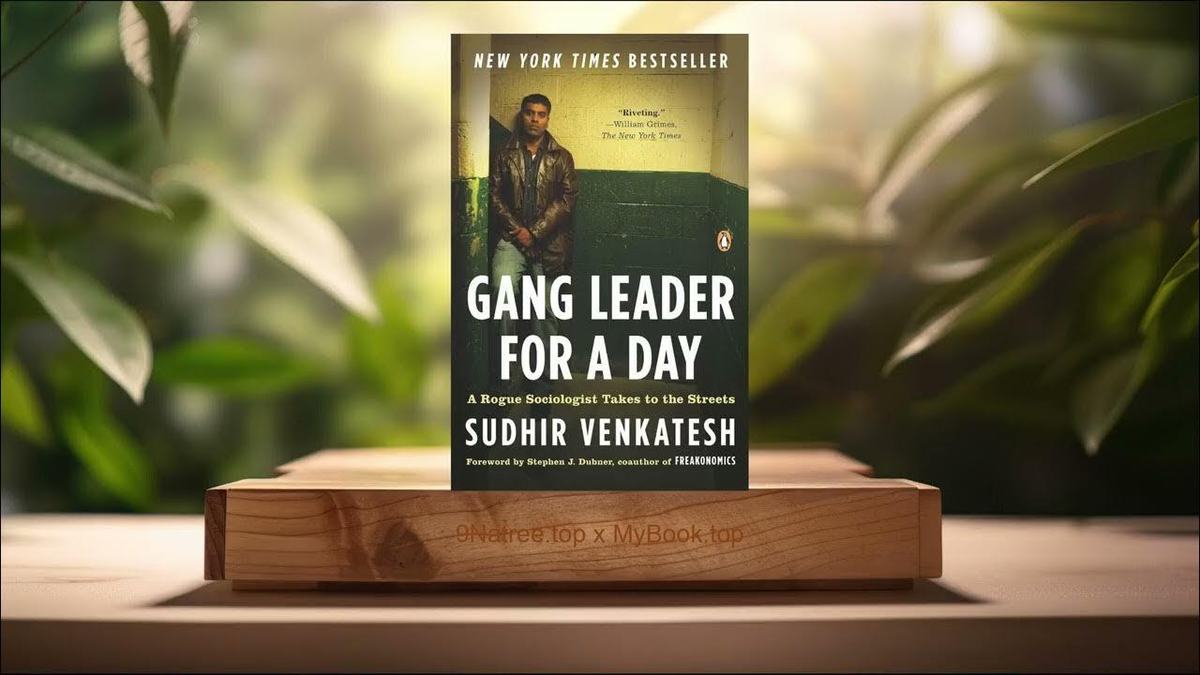

When Indian-American sociologist Sudhir Venkatesh decided to leave the lecture hall at the University of Chicago and go down to the 'Robert Taylor' housing complex controlled by gangs, he could not have imagined that his experience would later become a book titled: 'Gang Leader for a Day.' This experience would offer profound lessons for anyone working in social change and nonprofit work.
This article attempts to read the book through the eyes of someone working in the nonprofit sector; a worker who is asked to 'study needs' and 'understand the reality of beneficiaries,' while they are – often – far from their neighborhoods, language, and real pains.
'Robert Taylor'… the neighborhood that no one understood
Venkatesh describes the 'Robert Taylor' complex in South Chicago as a world with its own language, values, and internal system; a cohesive community trying to protect itself from poverty, racism, and marginalization.
The state built the buildings and then left them to decay, and social programs are no longer sufficient to ensure food and healthcare, filling the void with gangs that imposed their own laws.
From a distance, the image seems simple: a poor neighborhood controlled by drug gangs. However, living in the place for years revealed to the researcher that:
- Many families saw gangs as an 'alternative system' providing protection and income.
- Young people do not choose crime out of a love for violence, but as an escape from the closure of legal opportunities.
- Amidst the violence, there remained humanity; neighbors help each other, celebrations are held, and strong relationships are formed.
This contradiction between the distant perspective and the inner life is exactly what the nonprofit sector faces when it relies on ready-made mental images of 'the poor' and 'marginalized neighborhoods' without going to live among them, even for some time.
Between surveys and living experience… the limits of cold data
At the beginning of the book, we see Venkatesh holding a traditional academic survey, trying to ask standardized questions of the youth in the neighborhood, who mock him, threaten him, and then drag him to gang leader 'G.T.' His first message to him was simple and harsh at the same time:
This method is not suitable for studying our lives.
This scene exposes a form of 'needs assessment' that we sometimes practice in organizations:
- A ready-made model of questions.
- A quick visit to a neighborhood or village.
- Numbers are collected, and tables are filled out, then the teams return to their offices.
The result: Lots of data, but little understanding.
In contrast, Venkatesh chose a different path; he left the researcher's chair behind the glass and began living in the neighborhood, sitting with gangs, attending their events, observing the details of their day. The study transformed from 'written questions' to 'shared life.'
Lessons for the nonprofit sector:
- Surveys are important, but they are not the beginning; the beginning is building trust and entering people's world in their language.
- Direct observation is irreplaceable; you cannot understand the context of poverty without seeing the houses, schools, markets, and the way people communicate.
- Time is part of the methodology; needs assessment cannot be completed in a single photo session or workshop, but requires a long breath.
Crime is not the opposite of humanity… but sometimes a mask for it
In one striking segment of the summary I heard on 'Wajiz', Venkatesh states – in essence – that amidst violence and crime he saw a world that had not lost its humanity; gangs that trade in drugs and extort, yet at the same time a cohesive community that defends its members, celebrates with them, and lives its own rituals.
This does not mean justifying crime, but reminds us that:
- The beneficiary we encounter at the association is not a 'case' or 'identity number,' but a human being carrying contradictions like us.
- The young person involved in deviant behavior may simultaneously be a dutiful son, a caring brother, or a generous neighbor.
- Social interventions that ignore this complex humanity easily turn into general judgments and into more repressive and moralizing projects than development programs.
Nonprofit work based on living needs does not shy away from these complexities; rather, it sees beneficiaries as they are, not as we would like them to be, and then tries to open different pathways for them, not punish them for their past.
When law allies with power… who protects the weak?
One of the harshest parts of the book is what Venkatesh recounts about the unspoken partnership between the police and gangs in Chicago; how the law can turn into a shield protecting the powerful and leaving the poor alone in facing violence and drugs.
From the perspective of the nonprofit sector, this reminds us of two things:
Protection systems alone are not sufficient
The existence of regulations, governance guidelines, and directives from regulatory authorities is important, but it does not guarantee justice if they are not translated into procedures that consider the weak. The process of applying for assistance can be 'legal' but may actually impede those in greatest need due to paperwork complexities or difficult verification criteria.
The role of organizations is not just to provide service but to advocate for justice
When an organization discovers – through its experience in the neighborhoods – that there is a structural flaw perpetuating poverty (discrimination in the job market, substandard housing, systemic domestic violence…), it becomes its responsibility to raise its voice and convey this truth to decision-makers, not to merely distribute aid.
The law can serve development if it is placed in the hands of those seeking justice, and it can reinforce injustice if used merely to protect interests. This truth is only visible when we approach reality as Venkatesh did.
The dangerous proximity… how to live with people without losing professional distance?
The author describes his relationship with gang leader 'G.T.' as 'an unusual, morally ambiguous relationship' yet also strong to the extent that the leader felt he owed him personally when he helped save a friend’s life. This relationship reveals the cost of field immersion: the closer you get, the greater your responsibility, and the higher the risk of bias.
In nonprofit work, the field worker faces a similar dilemma:
- If they remain distant, their programs remain superficial and abstract.
- If they completely dissolve into the community they serve, they may lose the ability to make tough decisions, assess risks, or anticipate side effects.
What is needed is a professional closeness:
- We listen deeply to people's stories but do not allow the story of one individual to hijack the entire program design.
- We build trust relationships, but clarify – to ourselves and the beneficiary – the limits of this relationship, and that we represent an institution with regulations.
- We allow reality to change our assumptions, without letting it drag us into justifying destructive behaviors under the guise of 'understanding.'
Venkatesh learned from his experience that entering people's world is not a simple ethical decision; it is a responsibility that requires awareness, and this is an important lesson for every organization sending its teams into the field.
What is 'needs assessment' when we take it seriously?
If we tried to summarize the lessons presented in the book in the form of practical principles for the nonprofit sector, we could say that needs assessment based on living experience means at least four things:
1. Moving from offices to the field
That the organization has a structured program for visiting neighborhoods, not for 'media documentation,' but for listening and observing:
Who sits in the cafes? Who gathers at community centers? Which shops thrive and which close down? How do people talk about their problems?
2. Involving local residents in defining their problems
As happened with Venkatesh when the youth corrected his initial hypotheses; it is not enough to define needs from the expert's perspective. We should ask:
How do local residents describe their problem? What name do they give it? What solutions have they tried before?
This protects us from designing projects that address 'our problem' rather than 'their problem.'
3. Looking at structural obstacles, not just symptoms
The book links poverty, racial discrimination, the labor market, education, and drug trade. With this perspective, the problem is no longer 'wayward youth', but a complete system pushing them toward this path.
In the nonprofit sector, this means that:
- Helping the family with rent is important, but we must also ask about the housing market, support systems, and job opportunities in the area.
- An academic support program for children is nice, but what about the quality of the school, classroom overcrowding, and the family's ability to follow up with their children?
4. Time is a partner in understanding
Venkatesh spent years in the neighborhood, witnessed the rise and fall of the gang, changes in laws, and market transformations, and emerged with a completely different conclusion from the one he started with.
Organizations that change their operational areas every year or shift priorities with every new grant deprive themselves of this temporal depth. Needs assessment is not just a report produced at the start of the project, but an ongoing pathway of learning and adjustment.
From 'Gang Leader for a Day' to 'Initiative Leader for Years'
The author may not have intended to write a guide for those working in the nonprofit sector, but he provided – unintentionally – the closest living model to what we today call 'participatory research' or 'community-based development.'
The difference between the world of gangs he saw and many of our charitable programs is not in the severity of poverty or the magnitude of pain, but in the way of looking:
- Gangs saw in the void an opportunity for control and gain.
- Nonprofit organizations are called to see in the same void an opportunity for justice, empowerment, and building alternatives.
But we cannot create these alternatives from a distance. We need initiative leaders who resemble – in their field courage, not in their ethical choices – Venkatesh's experience:
They take off their formal coat a little, enter the alleys, hear people's stories as they are, and then return to the planning table having changed themselves first before changing the programs.
When we take off the formal coat and enter the neighborhood
'I did not know what it meant to be a gang leader until I tried it myself,' says Venkatesh at the conclusion of the book.
Workers in the nonprofit sector do not need – nor should they – to experience gang life, but they need to honestly ask themselves:
Do I really know what it means to be a 'sponsorship program officer,' or 'empowerment initiative manager,' or 'needs assessor,' before I spend a whole day living with the families I claim to work for?
The book 'Gang Leader for a Day' reminds us that social justice is not created from excellent reports alone, but from eyes that see reality up close, hearts that can bear contradictions, and minds capable of transforming this deep understanding into more humane and effective programs.
The first practical step after reading these lines might be to ask your team in the association:
When was the last time we lived a whole day in the neighborhood we work in… without cameras, slogans, or paperwork, just to listen?

Comments (4)
No comments yet. Be the first to comment!