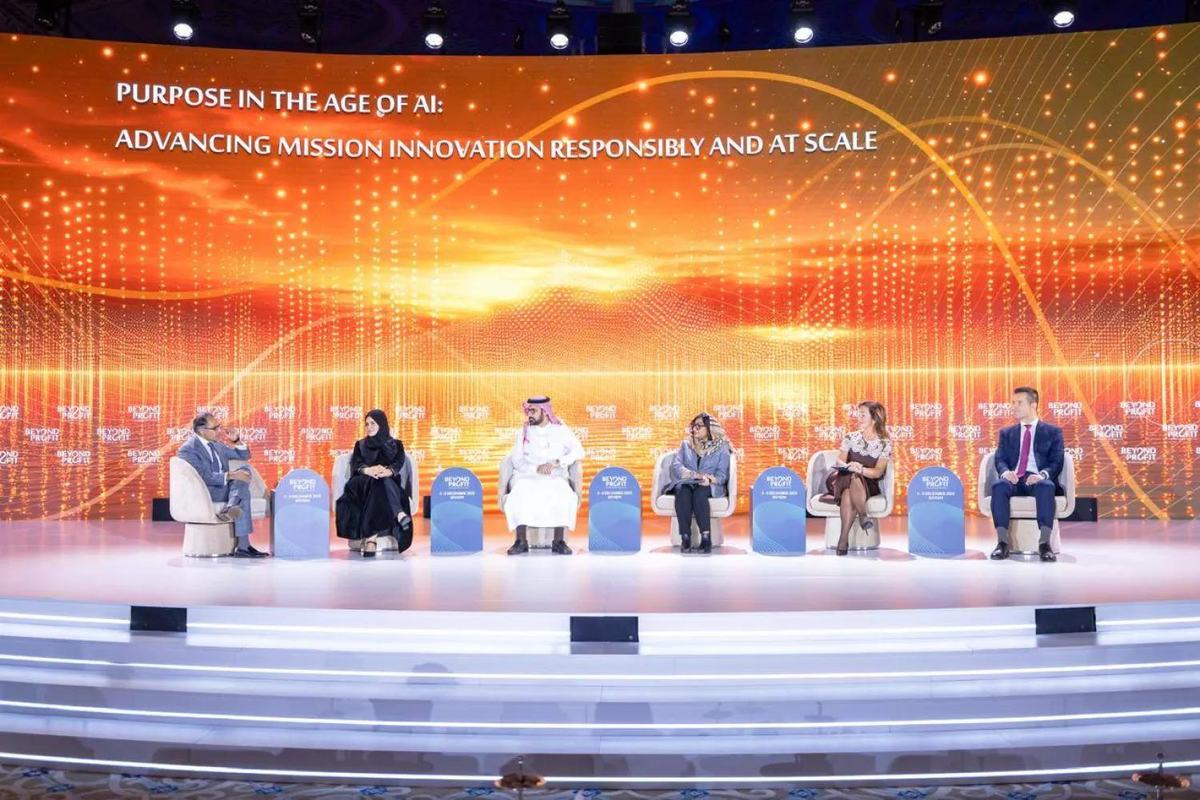

For three days, from December 3 to 5, 2025, Riyadh hosted the 'International Nonprofit Sector Forum (Beyond Profit)', organized by the National Center for the Development of the Nonprofit Sector, as a global platform redefining the place of this sector in the Saudi and international development scene. The forum was not just a gathering of elites but a space where governments met with donors, associations with social entrepreneurs, and experts with practitioners, all under one roof discussing impact, governance, and sustainability in multiple languages. What occurred in its halls suggests that we are at a turning point in the history of the charity system in the Kingdom, unlike anything that came before, and paving the way for what will come after.
The 'International Nonprofit Sector Forum (Beyond Profit)' was not merely an event added to the crowded calendar of conferences in Riyadh.
To those who entered its halls consciously, it was a genuine civilizational shock for the nonprofit sector in all its components; a shock that calmly states:
What was before the establishment of the National Center for the Development of the Nonprofit Sector is one thing… and what follows is something else,
and what existed before 'Beyond Profit' is one thing… and what comes after will never resemble it.
I entered the hall carrying an old image of the sector: a generous donor, a modest association, a silent beneficiary, and a blessing of good descending upon all.
I left with a completely different map:
A new language, modern tools, and pathways of work discussing artificial intelligence, innovation, empowering civil society, a new generation of giving, as the forum distributed its time between a main platform, field workshops, and an innovation platform, featuring titles like: 'Goals Create Policies', 'Artificial Intelligence in the Service of the Message', 'The Return from Giving', and 'Post-2030'.
In this new map, the National Center is pulling the entire sector forward with strength, while some are trying — from afar — to catch their breath after the first punches of change.
Who originally kidnapped the sector?
The question some are discussing backstage today:
Who kidnapped the nonprofit sector?
The easy answer is to blame the 'new experts' or 'social investment language' or 'globalization' or even 'the National Center'.
But the reality is less romantic and more disturbing:
The sector, for many long years, was not kidnapped as much as it was left to a silent alliance within the charity system itself:
- A donor preferring a pliable sector,
- An association willing to accept the bare minimum of organization,
- Leadership accustomed to the old privileges,
- And a community and media environment tolerant of ambiguity as long as the title is 'charitable work'.
At the heart of this unannounced alliance, we can see two clear images:
A donor wanting a sector that does not disturb him with questions
He writes the check, chooses the titles, prefers bright images in the reports, and is annoyed by too much talk about 'governance' and 'transparency' and 'impact assessment'.
He wants everything to stay under the table:
Prefer this amount… and do not ask me how the grant decisions were made, nor who was denied nor why.
And hawks of the sector guarding the old privileges
A narrow layer of leadership, accustomed to speaking on behalf of 'charitable work' as a whole, reserving front-row seats at every occasion, and living in a gray area between money, prestige, and religion.
They are not disturbed by the scattered associations, nor by the short-lived projects, nor by the beneficiary remaining just a number in a final report, as long as the lights are directed toward them.
All of these are a small part of the charity system, but they — intentionally or unintentionally — allowed the sector to be managed under the logic:
'Good intentions are enough, and there’s no need to disturb people with impact questions.'
So the kidnapping was not a conspiracy, but rather a result of a mix of habit, laziness, and refusal of accountability;
an investment in 'the reputation of giving' more than in the impact of giving.
The National Center: An adversary of the system or a chance to save it?
When the establishment of the National Center for the Development of the Nonprofit Sector was announced in April 2019 and its organization was approved in June 2021, some read it as an additional oversight authority, or an entity that would complicate what had been run by consensus and custom.
But those observing the scene after years realize that the center is doing what should have been done long ago:
It organizes, unifies, sets rules, demands numbers, and links the sector with a vision of a state that wants to see a real impact, not just pictures.
The paradox is that most of those who complained about the center's role are precisely those who have long been comfortable with the logic of 'let us do good in our own way':
- A donor who does not want to justify his decisions,
- An association that does not want to reorganize its internal structure,
- And an old leader who cannot stand being asked: What have you done with all these budgets and all these years?
The center, contrary to what is sometimes rumored, is not a 'new kidnapper' of the sector, but rather the traffic cop who arrived late after the intersections became congested and accidents became almost daily.
Its existence means that the time of 'do whatever you want and call it good' is nearing its end, and that the entire charity system is invited to adapt to new rules of the game.
'Beyond Profit': The mirror that was put in front of everyone
What 'Beyond Profit' did is nothing less than putting a massive mirror in front of the entire sector:
This is the world today, and this is the language it speaks about impact, funding, governance, volunteering, and innovation, so where are you?
The forum was not made just to take pictures, but to state clearly:
- That associations that do not know how to measure their impact will find themselves out of the game.
- That donors who rely on the label 'good intentions' will be questioned about the efficiency of their decisions.
- That the hawks of the sector who were accustomed to monopolizing the scene will have to share the platform with a new generation of leadership; more educated, more connected to the world, and less willing to accept 'silence for salary'.
- And that the volunteer is no longer 'spare time' but 'human capital' about which the forum discusses burnout, empowerment, and its role in economic and social growth.
The real shock at the forum is not in the foreign terminology or the international guests.
The shock is that the Saudi nonprofit sector — for the first time so clearly — declares that it will not accept remaining a margin in the equation of national development, and will not allow the charity system to be managed under the logic: 'The good doers know what they are doing, so don’t ask'.
The charity system under the microscope
Let’s say it bluntly:
The Saudi nonprofit sector today is legislatively and organizationally advanced thanks to the National Center, but it still needs a deep review of the entire charity system's culture:
- In the way some donors think,
- In the management styles of some associations,
- In leadership models,
- And in societal and media expectations from this sector.
There are donors who want:
- Detailed reports about every riyal,
- And complete loyalty from the association,
- And respectful media appearances,
But the entire system — not just the donor — in many cases still feels awkward about questions like:
- What are the criteria for selecting the entities and projects?
- Is the distribution of grants fair between regions and categories?
- What is the truly acceptable level of administrative costs?
- And what is the real impact that these billions have achieved over an entire decade, on poverty, education, health, and quality of life?
Some associations, in turn, have become accustomed to receiving rather than negotiating, to writing reports that please the donor more than honestly stating the truth, and to keeping the beneficiary in the background while everyone advances to the picture.
'Beyond Profit' — whether the parties like it or not — put the entire charity system under a strong light:
The lights in the hall talk about transparency, governance, smart funding and equity in distribution, about professional volunteering, and about a new generation of impact leaders.
In this lighting, the question is no longer: 'Is the donor wrong?'
But rather: 'Is the entire system ready to deal with a new era of questions?'
The hawks of the sector… and the crisis of moral retirement
As for the 'hawks of the sector' who were accustomed to leading everything, they are facing a different kind of crisis today:
A crisis of moral retirement.
A new generation enters the hall: young leaders, women and men, speaking the language of numbers, technology, and international partnerships, linking 'good' with 'sustainability', 'charity' with 'justice', and 'initiative' with 'public policy'.
These do not wait for permission from anyone, nor do they see the sector as just a space for public relations and social appearance.
The forum revealed — without declaration — that the sector no longer needs a 'sole leader' to define its path, but a wide, diverse leadership system that relies on knowledge rather than personal history.
And some of the hawks of the sector who do not want to accept this reality will find themselves, in a few years, telling their friends about 'the good old days' while the table is managed without them, and with tools they have not learned to deal with.
After the shock: will we catch up or complain?
The most important question remains: What after this civilizational shock?
We have two obvious choices:
- To stand outside the hall, criticizing the forum, doubting intentions, and talking about the 'old charitable spirit' that is lost, and then wake up after years to find that the sector has moved on without us.
- Or to understand the message as it is:
That the National Center is opening a wide door for anyone who wants to be part of the future,
and that 'Beyond Profit' connects us to global standards,
and that the entire charity system — donors, associations, leaders, volunteers, and media — is called this time to an exam seat, not just an honor seat.
The transformation led by the center will not wait for the hesitant.
And those who think the sector will return to what it was before the center and before the forum are betting on a time that will not return.
After 'Beyond Profit': The bias towards what should be
What is happening today is that this sector is facing its first serious confrontation:
- A national center writing the rules of a new game.
- An international forum linking us to the world and exposing us to its standards.
- And a charity system being gently and firmly pushed to a phase where it is not enough to be 'well-intended'; rather, to be highly efficient, clearly impactful, and honest with numbers.
The message that 'Beyond Profit' directs to some donors and hawks of the sector, and to associations and the community alongside them, is not a threat but a call:
Either you catch up with the transformation… or make way for those who want to serve this country and these communities with a new mind.
What comes after the establishment of the center is not like what came before it.
And what comes after 'Beyond Profit' will not resemble what preceded it.
The Saudi nonprofit sector has entered a phase that does not need those who cry over the past,
but rather those who have the courage to acknowledge what was, and the bias towards what should be.

Comments (4)
No comments yet. Be the first to comment!