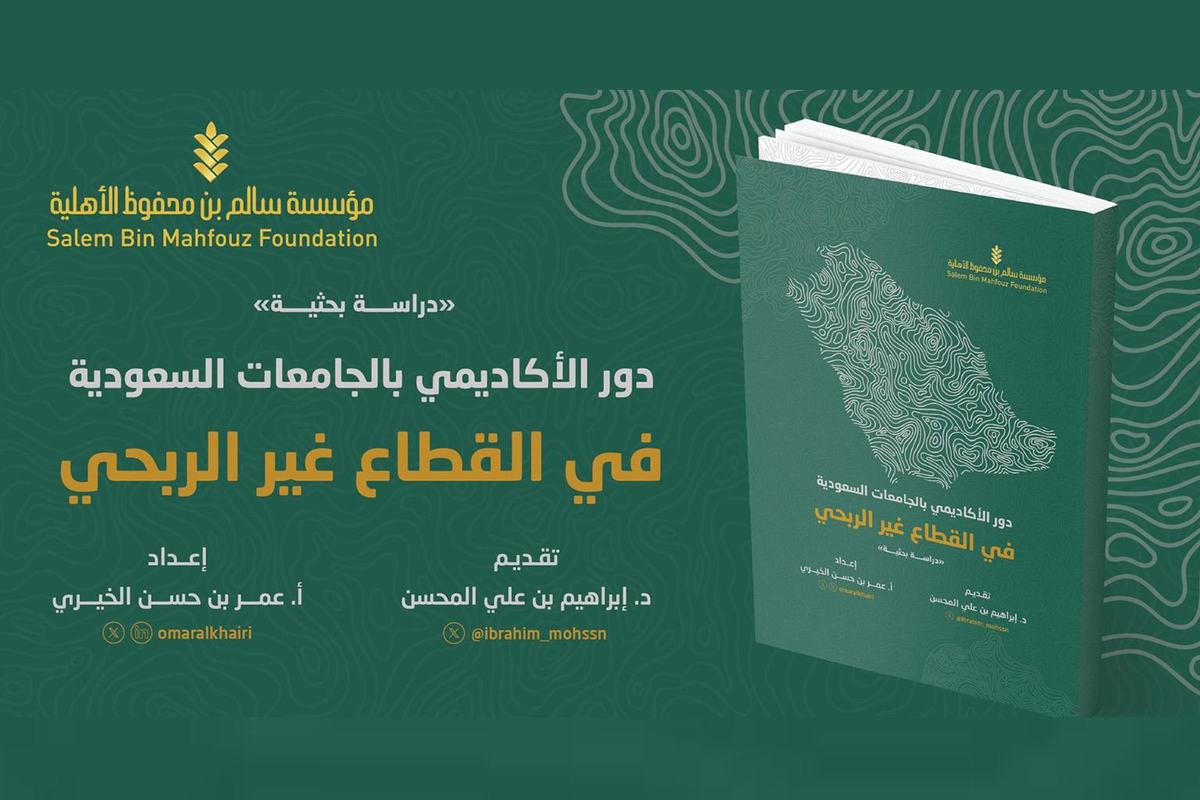

In an era where national development paths intersect with the goals of Saudi Vision 2030, the presence of academics in the knowledge scene is no longer sufficient unless it is accompanied by a tangible impact on society. From this standpoint, the research study "The Role of Academics in Saudi Universities in the Non-Profit Sector" gains its importance; it represents a qualitative scientific effort that explores a space not sufficiently addressed: How can an academic be a genuine partner in building the non-profit sector?
From Knowledge to Practice
The study starts from a central hypothesis that universities are not isolated islands but stores of knowledge that should be translated into practical applications through scientific research, consultations, training, and participation in developmental initiatives. In doing so, it redefines the relationship between academics and the non-profit sector from being a "limited support" to a "systematic institutional partnership".
General Framework: Broadening the Horizon
In its first chapter, the study presented a comprehensive framework for the non-profit sector, addressing concepts of governance, funding, and idea entrepreneurship, to illustrate the extent of opportunities and challenges facing academics. The critical review of previous studies revealed that the academic role has often remained on the margins, which explains the gap between theoretical knowledge and practical application in the field.
Methodology: Rigor and Objectivity
The study was built on precise scientific tools, its data collected from a diverse academic community, and then analyzed using the SPSS software, which gave it statistical power that enhanced the credibility and reliability of the results.
Results: Uninvested Capacities
The results clarified that academics possess influential capacities that support the non-profit sector in areas such as planning, training, and policy formulation, but these capacities remain below the required activation level. The study concluded that this is due to the weak institutional linkage between universities and non-profit organizations, necessitating the engineering of new channels for partnership.
Recommendations: A Practical Roadmap
The study provided a package of recommendations, the most prominent of which are:
- Organizing targeted training programs and courses for academics on the non-profit sector.
- Integrating academic experts into governance structures and decision-making within associations.
- Establishing digital platforms for exchanging experiences and research between universities and organizations.
- Adopting scientific measurement indicators of the impact of academic participation in development.
Value and Impact of the Study
What distinguishes this study is that it does not only pose questions but also outlines a realistic roadmap to activate the role of academics in serving society, emphasizing that sustainable development in the Kingdom needs a combination of scientific power with field needs.
A Word of Appreciation
The researcher Professor Omar bin Hassan Al-Khairi deserves appreciation for this solid research work that has added a new brick to the wall of knowledge about the non-profit sector. We also commend Dr. Ibrahim bin Ali Al-Mohsen – the CEO of the Suleiman bin Abdulaziz Al-Rajhi Charitable Foundation – who presented the study and embraced it in the name of a leading foundation in supporting sustainable development. We must also applaud the support of the Salem bin Mahfouz Charity Foundation that contributed to enabling this research project to come to light and reach the field.

Comments (3)
No comments yet. Be the first to comment!