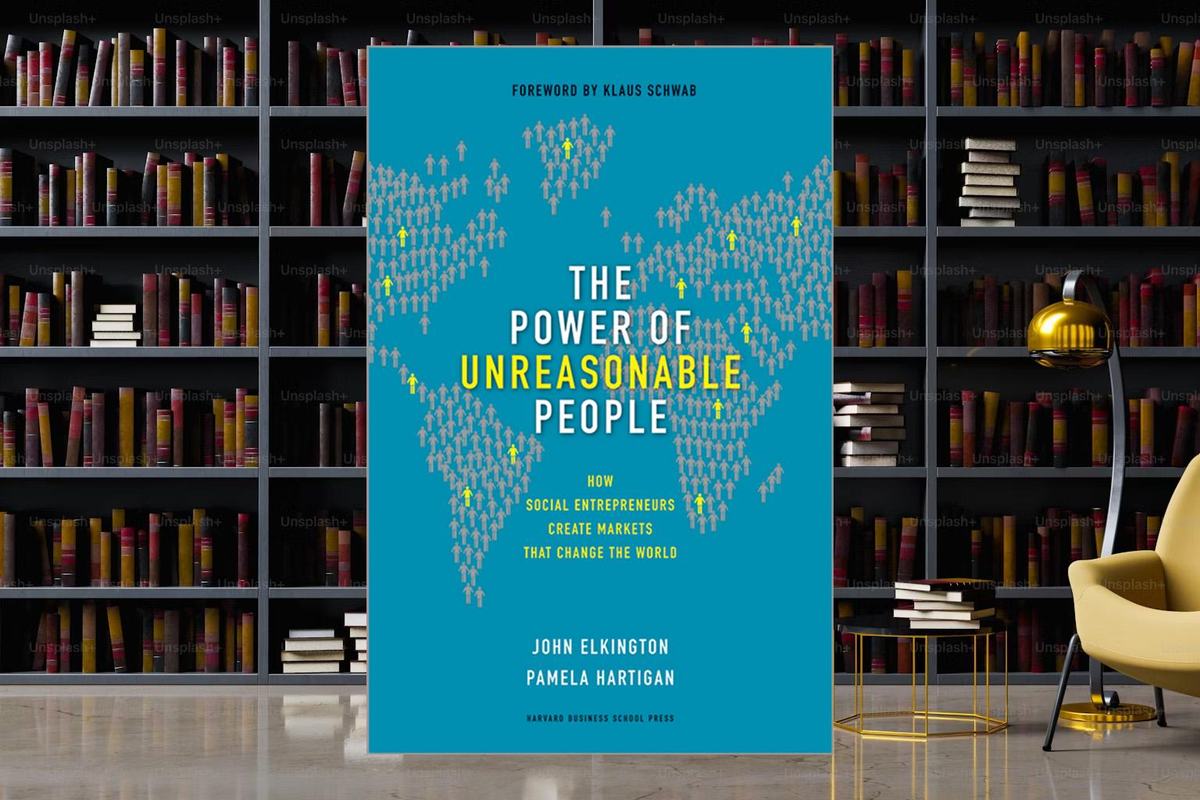

In a world where economic, social, and environmental transformations are accelerating, traditional models alone are no longer sufficient to understand the roots of challenges or provide effective solutions. Here, the role of "social entrepreneurs" emerges, who, in the authors' words, act as "unreasonable people": they refuse to accept reality as it is and insist on changing it no matter how illogical that may seem.
In this book published by Harvard Business School in 2008, John Elkington and Pamela Hartigan present an analytical journey through more than fifty global experiences of people who were initially labeled as "crazy", before being later recognized as creators of new models and markets.
In this review prepared by "The Third Bank", we highlight the essence of the book and review the models and practices that can be adapted or inspire the nonprofit sector in Saudi Arabia, in its quest for greater sustainability, deeper impact, and more resilient and innovative models.
Who Creates Change? Those Who Refuse Reality.
When George Bernard Shaw said, "The rational adapts to the world, while the unreasonable insists on adapting the world to himself; thus, all progress depends on the unreasonable ones", he was not aware that this saying would become a cornerstone in the literature of social entrepreneurship in the 21st century.
In fact, this perception is not new to Islamic thought. It is recorded that the Prophet ﷺ was described in Mecca as "the madman", "the sorcerer", and "the deviant from his people", not for any other reason except that he came with an unfamiliar model that turned social and economic balances upside down at the time. And those who followed him among the great reformers walked the same path: Ibn Taymiyyah was exiled and imprisoned and accused of intellectual deviation, Ahmad ibn Hanbal was beaten during the creation of the Quran controversy, al-Shawkani faced isolation from the scholars of his time, and Avicenna was accused of heresy and extreme rationalism in his time.
But all of these changed the course of thought and humanity not because they were in harmony with their time, but because they dared to break free from the closed collective cage of reason.
3 Models for Rebuilding the Market for People
The authors propose a deep classification of social entrepreneurs, divided into three main models, each reflecting a different vision of the relationship between nonprofit organizations and the market and financing:
1. Leveraged Nonprofit Ventures
They rely on charitable or governmental funding, but use it wisely to expand their impact.
Example: Barefoot College (India)
A foundation established by Bunker Roy, it relies on training illiterate women in remote villages to install solar energy systems themselves, without certificates or official qualifications, but based on community knowledge. The idea seemed crazy to many, but it has become a global model for localizing technology and empowering communities.
2. Hybrid Ventures
They combine self-generated revenue and nonprofit financing, creating business models that suit communities.
Example: Rubicon Programs (USA)
An organization that started as a support entity for rehabilitating the homeless and those with mental challenges, then transformed into an economic operator owning bakeries, landscaping coordination centers, and employing hundreds annually. The project generates millions in income but does not lose its social compass.
Example: Aravind Eye Care (India)
A revolutionary medical model that treats over 60% of patients for free, relying in its funding on a segment that pays a nominal fee. Thanks to operational efficiency and excellence in cost management, the hospital performs over 2.8 million operations annually, with a self-sustained budget, and a model studied at Harvard and the Indian Institute of Technology.
3. Social Business Ventures
They operate as for-profit companies, but their main goal is social or environmental impact.
Example: Sekem (Egypt)
Launched by Dr. Ibrahim Abouleish, it became a comprehensive system including organic agriculture, factories, schools, an alternative medicine center, and export projects to the European Union. The project does not rely on donations but on the revenue generated from product quality and the depth of its community message.
Example: La Fageda (Spain)
A dairy company in Catalonia that employs patients with mental health issues. It started as an idea considered “unrealistic” by society, but today it competes with companies like "Danone" and "Nestlé", providing a work environment that transforms the beneficiary from the role of "patient" to the role of "proud producer".
Example: Whole Foods (USA)
A chain of stores founded by John Mackey, considered one of the most successful environmental companies, proposing an advanced concept of "conscious capitalism", where the company considers the interests of farmers, the environment, and consumers, while also achieving substantial profits.
Not All "Madness" Is a Quick Victory
It is important not to be deceived by the image of the "inspiring irrational person" as if they are always successful from the first moment. Radical innovation is often met with ridicule, skepticism, and resistance. Many of the projects mentioned in the book—such as Barefoot College or La Fageda—went through phases of setbacks, loss of funding, media vilification, and sometimes even legal threats.
The irrationality here does not mean jumping into the unknown, but rather the courage to take calculated risks, the ability to stand up again after every defeat, and the understanding that the path to radical change is paved only with long patience and value discipline.
How Does This Book Benefit Nonprofit Workers?
Moving Beyond the Logic of “Aid” to “Model”
The book calls for a transition from merely providing assistance to building solutions in which beneficiaries participate and own the tools.
Financing Is Not the Goal but the Tool
All successful models did not start with ample financing, but with a bold idea that then matured towards self-financial empowerment.
Unconventional Leadership Is the Cornerstone
No founder of these projects was a “systematic leader.” They were all “unreasonable” by prevailing standards.
From Saudi Arabia to India: Can We Replicate These Models Locally?
- Programs such as Housing Project or Family Development Centers can be redesigned to adopt sustainable hybrid models, linking vocational training with the labor market.
- Health and community associations can adopt models similar to Aravind, such as providing free services with partial self-funding.
- Agricultural associations in southern and western Saudi Arabia can draw inspiration from Sekem in transforming into integrated production chains with environmental and economic impact.
The Unreasonable Are Not Mad… but Ahead of Their Time
This book reminds us that every major social development started with an "unfamiliar" idea, and perhaps "disturbing" at the time.
But their owners were not merely dreamers, but builders of alternative systems.
In the Saudi context, how much the nonprofit sector today needs "brilliant irrationalists" who can move beyond the logic of imitation, redraw the relationship between society and financing, between service and empowerment, and between need and innovation.
Those who want to be part of the solution must do more than just implement… they must innovate.

Comments (4)
No comments yet. Be the first to comment!