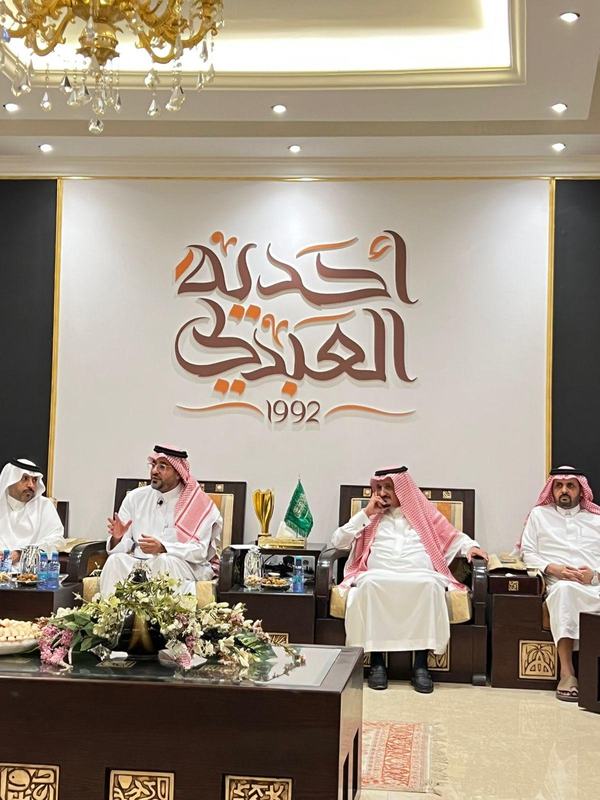

On the evening of Sunday, September 28, Abdali's gathering was not just an ordinary council where attendees discussed matters of culture and knowledge, but an open space that hosted a discussion about a sector undergoing unprecedented transformations in the Kingdom: the non-profit sector.
The evening, which was managed by Dr. Obaid Bin Saad Al-Abdali, a well-known marketing professor and the owner of this esteemed council since 1992, brought together faces from researchers, media professionals, leaders, and enthusiasts to listen to the experience of Ahmad Bin Ali Al-Suwailem, the CEO of the National Center for the Development of the Non-Profit Sector.
The Council… A Place of Memory and the Spirit of Humanity
For three decades, the gathering has remained a space for quiet dialogue and openness, where knowledge intersects with personal experiences. Al-Suwailem's attendance was not just an official participation, but an extension of the spirit of the council that gives the guest the chance to speak in a language closer to humanity than that of reports. Al-Suwailem thanked the host and praised this platform that "its echo reaches all parts of the Kingdom," as one of the attendees described it.
A Rapidly Growing Sector… From the Margin to the Heart of Vision
Al-Suwailem began his talk by drawing a striking analogy, comparing the non-profit sector to a "bank" that connects those who have money with those who have ideas. He then went on to paint a digital picture: from 1,600 associations only in 2017, the number has now jumped to over 6,500 associations, reflecting the Saudi community's passion for giving.
This growth was not a coincidence, but rather a result of the leadership's interest, which itself established humanitarian institutions and associations, and integrating the sector into the Saudi Vision 2030 as a strategic partner in health, education, insurance, and culture.
The National Center… From Bureaucracy to Efficiency
When the center was established in 2019 and officially began in 2022, it faced a dual task: protection and empowerment. Al-Suwailem reviewed the most significant transformation: reducing the time required to establish associations from many years to only 20 working days.
He also reviewed the new governance system that not only checks founding documents but follows up on 100-day plans, bank accounts, financial reports, and field visits. All of this aims to enhance the level of trust and transparency, at a time when some associations face media attacks and repeated rumors.
"We are Saudi Muslims"… Confronting Rumors with Trust
In a striking candidness, Al-Suwailem spoke about the "ferocious rumors" surrounding the sector, affirming that the response should not be in anger but in transparency and clarification:
"We are Saudi Muslims, and it is not in our nature to accept tarnishing the reputation of charitable work. We want the community to communicate with us directly and to be a partner in awareness."
New Platforms… and Necessary Apologies
One of the most notable revelations Al-Suwailem made during the meeting included:
- The launch of the “Sama for Beneficiaries” platform, similar to the financial “Sama”, to ensure equitable distribution so that beneficiaries do not receive the same assistance from more than one source.
- His apology for the issues that accompanied the new “Nawa 2” system, assuring that the center is addressing them urgently.
This transparency in acknowledging mistakes and clarifying the path reflects, as noted by some attendees, that the non-profit sector is beginning to emerge from the realm of "the sanctity that prevents criticism" into a space of accountability and transparency.
Between Governance and Stagnation
The interventions were no less rich than Al-Suwailem's own talk. Dr. Yusuf Al-Namla sharply commented on some donor associations that "have more regulations than employees," considering that excessive governance may turn into a burden hindering achievement.
This intervention served as a wake-up call, suggesting that governance, if not managed wisely, could shift the sector from safeguarding sustainability to bureaucratic paralysis.
Volunteering… From Free Hours to Economic Value
One of the points that sparked the interest of attendees was Al-Suwailem's discussion about volunteering. The Kingdom has already surpassed the target of Vision 2030, with the number of unique volunteers reaching 1.3 million by the end of 2024.
However, the new challenge is not in the number, but in the economic value of volunteer hours: from 60 riyals currently to 150, and then to 800 riyals in the future. Here, Al-Suwailem is not talking about a "symbolic contribution" but about a parallel economic contributor that benefits from citizens' qualifications and professional experiences.
The International Forum… A Date in December
At the end of the evening, Al-Suwailem announced the organization of an International Forum for the Non-Profit Sector in Riyadh next December, which will last three days and attract global expertise to showcase best practices, at a time when the Kingdom seeks to affirm its position as a regional and global reference in non-profit work.
The Gathering… A Memory That Does Not Age
It is worth noting that the meeting was not just a presentation of numbers or policies, but a profound human moment. Abdali's gathering, thanks to its captain Dr. Obaid Al-Abdali, remains, after 32 seasons, a place where stories intersect with policies, science with experience, and humanity with ideas.

Comments (4)
No comments yet. Be the first to comment!