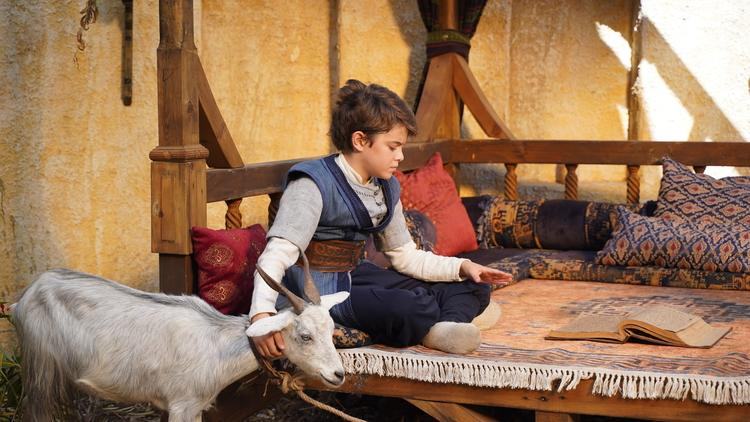

The goat "Socrates" was not just a creature to be raised, but a partner in a daily emotional experience, and thus the loss was harsh when Al-Harith sold it for the price of a garment he wore to appear handsome in the eyes of those he loved.
The scene extended to the grandfather, the elderly man who would take the chickens out of the cage every morning on a "tourist" round. It was not a whim of an old man, but a noble prophetic philosophy in dealing with creatures: to grant them their freedom, to appreciate their need for light and movement, and to treat the animal with dignity no less than that of a human being in its homeland.
On Friday, the sermon complemented the scene with the fear of Umar ibn Al-Khattab that a mule in Iraq might stumble, and he would be asked about it.
The Conscience That Precedes Law
Three moments that are not united by time or place, but they cohere in one idea: that the mute creatures are witnesses.
They witness either the mercy of their owner or his ingratitude.
They witness that man was not created on this earth to dominate it, but to preserve it.
The fear of being asked about the mule is not a transient feeling, but a deep awareness that the universe is not ruled by decrees alone, but by the responsibility that springs from within.
Kindness to the goat "Socrates" and the chickens is not a dramatic joke, but a practical education that the beings around us carry a spirit and deserve to be listened to, even when they are silent.
The Environmental Fund... A New Institutional Conscience
What I sensed in the Environmental Fund during my meeting with them is an attempt to transform that old conscience into public policy.
The initiatives they lead do not seek only to organize, but to reform.
The projects they launch do not merely aim to protect, but seek to redefine the relationship between humans and nature: a relationship of partnership, not domination.
In the vision of this team, the environment is not a bureaucratic file, but a living trust that requires us to reconsider the way we address people about it, and the way we build a stable awareness towards it.
As a development media center, we recognize that communication on such issues is no longer a luxury, but a moral and strategic necessity.
Environmental Media... From Voice to Meaning
It is not enough to raise our voices to protect the environment if we do not instill new meanings in society regarding its relationship with it.
Meanings that make dealing with trees an honor, with animals a commitment, and with rivers a pact.
Meanings that turn the image of the mule in the Friday sermon into a lesson in governance, and the tear of "Socrates" in the series into a moment of pure environmental awareness.
Here, the deeper role of environmental media manifests:
To build a language that connects people to the earth, not just through numbers, but through stories, symbols, and behaviors that nurture in the soul a new sense of responsibility.
The Environment Does Not Complain, But It Condemns
The earth has given us everything and has asked for nothing but not to burden its back.
However, in our race for expansion, we have forgotten that if the environment does not find anyone to protect it, it breaks silently... and then brings us down with it without warning.
The Environmental Fund, in its contemporary form, is not just an administrative body, but a moral bulwark, and an attempt to restructure public awareness around the environment as a legacy, not as a burden.
From Ibn Sina to Umar... From a Media Center to a Responsible Society
From "Socrates" associated with Ibn Sina to the mule that Umar feared to be questioned about by God, an invisible thread forms before us, linking man to his surroundings, not by utility, but by nobility.
Here, it is the duty of anyone carrying a developmental media message to contribute to forming this awareness, not just as a media actor, but as a witness to an era and responsible for a legacy we did not create but are tasked with maintaining.
The environment does not wait for a political discourse, but for a living human conscience that knows that the chicken that came out of its cage in the grandfather's house might be the truest expression of freedom from thousands of speeches,
and that the goat named Socrates, who parted ways with its owner, perhaps understood loyalty more than what is written in the books of wisdom,
and that the mule, which did not speak, is still writing the history of justice in silence more eloquent than words.
I leave you with excerpts from the first episode of the series The Little Genius, where Ibn Sina's knowledge is not narrated in classrooms, but in a moment of tenderness with a goat he named "Socrates", and in a silent dialogue with a grandfather who would take the chickens out of the cage, not to eat, but to see the sun.
https://youtu.be/oiVqXqqflS4?si=AGAVF55963yFZjTb
And not through organization, but through a vision that sees other beings as part of human trust on this earth.
There, in those small details, the first environmental education is manifested... not through slogans, but through action.
Hilal Bin Hussein Al-Qurashi
From caring for the silent, and listening to those who do not complain.
Perhaps the story begins from there...

Comments (3)
No comments yet. Be the first to comment!