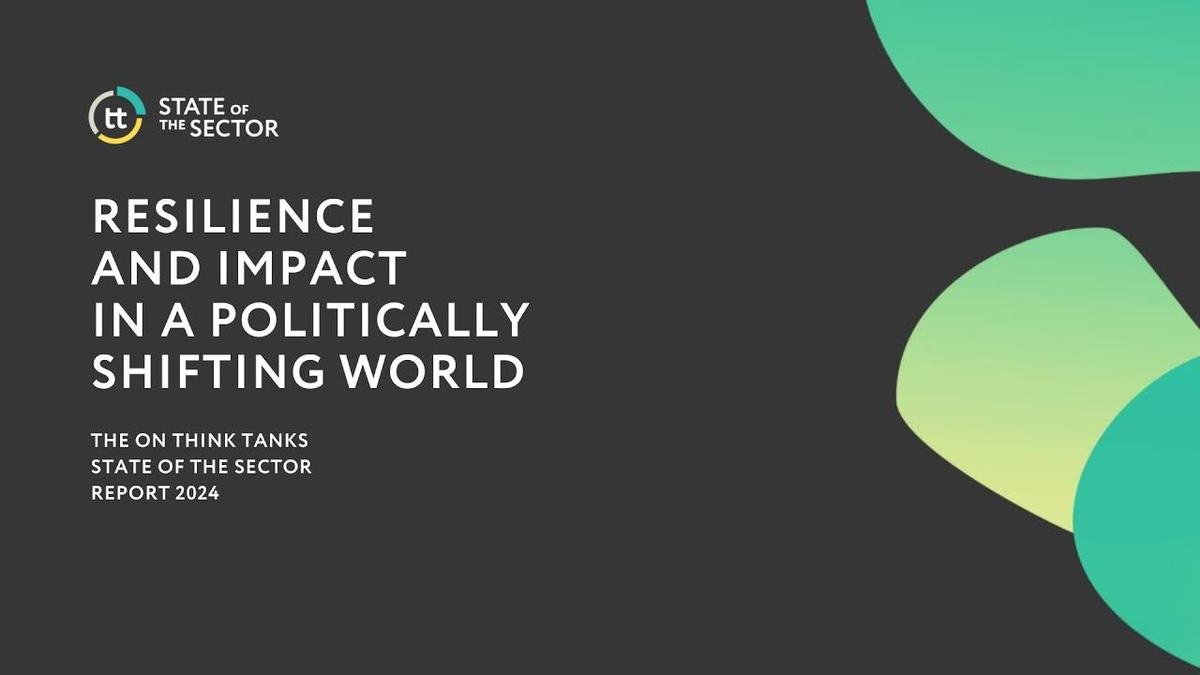

The On Think Tanks (OTT) platform is one of the leading global platforms that focuses on studying think tanks and analyzing their performance and impact on public policy. The platform has released its annual report for 2024 titled: State of the Sector: Think Tank Report Worldwide, which is considered one of the most comprehensive global reports on the landscape of think tanks in terms of funding, governance, institutional capacity, policy impact, and regulatory challenges.
The term "think tanks" refers to independent or semi-independent research institutions that produce knowledge and analysis aimed at influencing public decisions and policies. Their fields vary from economics, education, environment, social policies, and more. These centers occupy special significance in countries that seek to build decisions based on evidence and scientific expertise.
As part of its endeavor to enrich specialized knowledge in Arabic and facilitate access to global knowledge for those working in the non-profit and research sectors, The Third Bank | Knowledge Enrichment Encyclopedia for the Non-Profit Sector translated this report into Arabic, utilizing the GPT-4o AI model to ensure the accuracy and fluency of the translation, while respecting the contextual privacy of the Arab region.
This translation aims to open a knowledge window on the reality of think tanks globally, providing a mirror through which inspiration can be drawn for developing research platforms in the Arab world, especially in light of the rapid transformations occurring in the global political, economic, and technological landscape.
The On Think Tanks platform publishes this report annually to provide a comprehensive overview of the global think tank sector. This year’s report is based on data collected through a global think tank survey, conducted for the On Think Tanks (OTT) by the Once Once organization, relying on the Open Think Tank Directory database, in addition to information provided by 21 partner organizations.
For the first time this year, participants were allowed to maintain anonymity at the organizational level.
What Does the 2024 Report Offer?
This report provides in-depth insights into:
- Structural and organizational characteristics of think tanks,
- Staff size,
- Annual income,
- Geographical scope of their activities.
It also highlights political and funding contexts, aiming to understand how these factors affect the independence of think tanks and their ability to influence public policies.
For example, the report examines the impact of different governance systems and degrees of political polarization on research and communication efforts, and assesses the priorities of think tanks, their agendas, and their capacity to influence policy outcomes in various contexts.
New Trends: AI and Diversity
The report also addresses the extent to which think tanks engage with emerging trends such as:
- Artificial Intelligence (AI),
and Diversity, Equity, and Inclusion (DEI),
with an analysis of the differences in embracing these concepts between high-income and low-income countries, and an assessment of whether they are viewed as opportunities or challenges.
Potentially Surprising Findings
Readers may find some of the survey findings unexpected or contradictory, and some may attribute this to the sample not being fully representative.
However, the core value of this report lies in the opportunity it provides for discussion and interpretation of these results.
This report should be viewed as a tool within a broader process, inviting actors in the sector to:
- Compare their local reality with global data,
- Generate accurate analyses,
- and discuss critical questions for the sustainability of think tanks and their success in the future.
Partnerships and Local Analyses
To achieve this goal, the 2024 edition includes a new section featuring analyses and testimonies from our local partners, who provide their insights based on data related to their national or regional contexts.
Join Us as Well
We invite you to use the open data attached to conduct your own analyses and compare your local reality with the global landscape.
Finally, if you manage a research center, we encourage you to register it in the Global Think Tank Directory. The more participants there are, the more accurate and representative the "State of the Sector" reports in the future will be.
Thanks and Appreciation
We would like to express our deep gratitude to everyone who contributed to the success of the Open Think Tank Directory and the preparation of this report.
We thank the users of the directory who made our work relevant and valuable, and we appreciate the support of our extensive network of partners, friends, colleagues, and donors who assisted us in the survey and analysis processes, and contributed to understanding the data.
We also express our appreciation for the data collectors, and for the think tanks themselves for their engagement and responsiveness to our consultations throughout the process.
Funding
The development and maintenance of the Open Think Tank Directory has been made possible by the contributions of many donors, and it continues to be so today.
- The Open Society Foundations provided the initial grant that enabled the launch of the directory in 2016.
- The Energy and Climate Change Program in Latin America of the Konrad-Adenauer-Stiftung e.V. funded a survey of think tanks in Latin America in 2017, focusing specifically on environmental and climate issues.
- UNICEF funded a survey of organizations working in areas and issues of priority to them in 2019–2020.
- Robert Bosch Stiftung supported a global survey in 2019–2020 that focused on topics of migration, peace and security, inequality, and the environment, and is currently providing long-term programmatic support to the On Think Tanks platform.
- A Think Tank Mapping Project in Strategic Markets for the Bill and Melinda Gates Foundation in 2021–2022 enabled the expansion of knowledge about this sector.
- USAID supported a data survey on think tanks in the USA and Panama in 2021.
- Finally, long-term funding from the Hewlett Foundation and OTT Consulting is what makes it possible to manage, develop, update, and analyze the Open Think Tank Directory continuously.
Main Highlights of the Think Tank Sector – 2024
Based on 297 responses to the OTT global survey for 2024
1. The Global Think Tank Landscape
Most think tanks are small
- More than 60% operate on an annual budget of less than $500,000
- Most employ fewer than 20 full-time staff
- Funding is primarily locally sourced
Relatively recent establishment
- 34% were established between 2010 and 2019
Leadership
- The majority are led by men from academic backgrounds
- Female leadership is more common in Latin America and the Caribbean
Staff
- Most employees are professionals with advanced degrees, aged over 35
Legal and functional structures
- Most are registered as non-profit organizations
- Key functions include: communications and governance
- Few have specialized teams in monitoring, evaluation, and learning (MEL) or fundraising
2. Political Context
Concentrated in electoral democracies
- Think tanks in democratic systems do not show higher levels of independence compared to authoritarian systems
- Challenges in reaching policymakers are similar across different governance systems
Political polarization
- 36% said polarization affects their research and operational work
- The most affected regions: Latin America, non-European Europe, and the Anglosphere
- Polarization hinders cross-political communication (39%) and limits funding diversity (29%)
Impact of polarization
- 3%: Severe impact
- 21%: Significant impact
- 32%: Moderate impact
- 24%: Minor impact
- 19%: No impact
Political aspirations
Think tanks in wealthy and democratic countries are more pessimistic
- Only 21% expect positive political outcomes in the coming 12 months
- Most optimistic: the Middle East and sub-Saharan Africa
- Most pessimistic: the European Union and Latin America
3. Funding Models
Funding Sources
- +60% are internationally funded in low- and middle-income countries
- 70% are locally funded in high-income countries
Reliance on project funding
- More dependent on international development agencies
- While core funding allows for greater source diversity
Budget Size
- Wealthy countries host think tanks with larger budgets
- Smaller centers rely more on a single donor
- Spend more time on reputation building and securing funding
Stability and Human Resources
- Core funding is linked to the presence of long-term contracts and lower difficulty in covering indirect costs
4. Research and Impact Priorities
Political Impact
- 77% of centers reported influencing policies through formal and informal channels
Impact Factors
- Organized teams, long-term contracts, high budgets, media engagement, and low political polarization
Target Audience
- Public sector (36%)
- Civil society and community organizations (20%)
- Academic and research community (20%)
Main Political Issues Globally
- Economic policies
- Governance
Who Sets the Research Agenda?
- Government entities (29%)
- Policymakers (23%)
5. Challenges and Emerging Trends
Major Global Challenges
- Ability to adapt (73%)
- Seeking new funding sources (59%)
- Leadership transitions (44%)
- Skills shortage (especially in medium-sized organizations)
Skills Needing Improvement
- Fundraising skills (66%)
- Research capabilities (37%)
- Communication skills (37%)
Diversity, Equity, and Inclusion (DEI)
- A rising focus in well-resourced young organizations, especially in high-income countries
Artificial Intelligence (AI)
- Viewed as a transformative future element
- Its usage is still limited and in the early stages in most regions
About the Report
The annual report from On Think Tanks titled "State of the Sector" provides a comprehensive assessment of the state of think tanks globally. The 2024 edition is the fifth in this series. Based on responses from a survey that included approximately 300 organizations from 95 countries, the report offers a comparative perspective on the key factors shaping the sustainability, impact, and future prospects of think tanks.
In an era of increasing complex political challenges, economic disruptions, and rapid technological change, think tanks can play a vital role as knowledge brokers in evidence-based decision-making processes. However, these centers face significant issues – from financial fragility and political polarization to the need to adapt to new approaches in engaging their audiences.
The data presented in this report offers an overview of the reality of think tanks around the world, showcasing the key trends, challenges, and innovations in the sector across five main dimensions:
- The landscape of think tanks: An overview of size, scope, and diversity in the sector, including differences in organizational models, leadership characteristics, and geographic focus across regions.
- The political context: An overview of how degrees of democracy, political polarization, and the extent of governments' acceptance of evidence impact think tanks' ability to conduct research, engage diverse stakeholders, and participate in policy discussions.
- Funding models: An analysis of how funding sources and mechanisms shape operating models, research agendas, and sustainability of think tanks, with a particular focus on regional disparities in these aspects.
- Research and impact priorities: An exploration of the main political issues and target audiences that think tanks focus on; the strategies and channels they use to achieve policy impact; and the challenges related to measuring and communicating that impact.
- Challenges and emerging trends: A discussion of the major operational and strategic challenges facing think tanks, from retention of talent, leadership transitions, to the need for integrating DEI principles, and emerging developments like AI.
This report does not aim to provide an in-depth interpretive analysis of the results, but rather offers a rich and useful insight into the think tank sector at a global level. We invite readers to explore these insights and share their analyses, interpretations, and observations, either through our social media channels, by writing a piece for the OTT platform, or by participating in events where we will present the report.
Explore the State of the Sector 2024 report issued by On Think Tanks to learn about the challenges, innovations, and impact of think tanks globally.
A Brief Note on Methodology
Regular readers of the "State of the Sector" reports produced by On Think Tanks may notice that the 2024 edition follows a slightly different approach compared to previous years.
In particular, while regional differences remain a central element of analysis, the classification and division of geographic regions have changed significantly in this report.
The current analysis is based on several specifically defined sub-geographic regions, which are loosely based on the "UN Sustainable Development Goals indicators classifications", with significant adjustments specifically designed for this report. The aim of this design is to find a balance between several factors that affect the work of think tanks, including:
Geographical location, national income level, development challenges, political and institutional traditions, cultural links, and others.
Major Changes in Regional Classification This Year:
A new category called "Anglosphere" has emerged, including:
The United States, Canada, the United Kingdom, Australia, and New Zealand.
Therefore, there is no independent classification for North America this year, and the United Kingdom has been categorized as part of the "Anglosphere" instead of Europe.
The reasons for this classification include:
- The number of responses received from these countries.
- The presence of distinctive and common cultural, political, and institutional ties among them.
- The nature of funding and operations for think tanks in these countries differs from those geographically linked to them, such as the relationship of the UK to the European Union.
Europe has been divided into two separate sub-regions:
- The European Union and the European Free Trade Association (EFTA) which includes Norway and Switzerland.
- Non-EU Europe and the Caucasus, which includes Turkey for political and funding context reasons.
In Asia:
- Central Asia and South Asia have been separated into two independent sub-regions.
- East Asia and South-East Asia have been combined due to a limited number of responses from these regions.
- The North African region has been merged with the Middle East to form one region known as the Middle East and North Africa (MENA).
- Sub-Saharan Africa represents a distinct sub-region covering the remaining part of the African continent.
- Since Australia and New Zealand are included in the Anglosphere, and no responses were received from any other think tank in Oceania, this region is not represented in this year's report.
Supporting Classifications in Analysis:
- Countries have also been classified according to their economic development level (low, lower-middle, upper-middle, high income), based on World Bank reports.
- Additionally, based on the political governance system (closed authoritarian, electoral authoritarian, electoral democracy, liberal democracy), according to classifications from the V-Dem project.
These classifications – although approximate – are based on reliable sources and provide a defensible framework for understanding the contexts in which think tanks operate.
Additional details on the methodology can be found in Annex 1 of the report.
Key Findings
An overview of the main trends, challenges, and innovations in the think tank sector across five core dimensions.
Funding Models
There is a clear gap between wealthy and less wealthy contexts:
Think tanks in high-income countries primarily rely on local funding,
while their counterparts in low- and middle-income countries heavily depend on international donors.
Core funding is associated with greater organizational stability and higher employee retention,
but is rare outside wealthy countries and often requires reliance on a limited number of funders.
Most centers in low-income countries operate on short-term grants from international sources.
Over-reliance on a single funding source presents a risk across all economic contexts,
especially in upper-middle income countries in the regions: the Middle East, the Indian subcontinent, non-European Europe, and the Caucasus.
The Think Tank Landscape
The sector is diverse in terms of size, focus, and organizational model,
with the majority operating on annual budgets of less than $500,000 and employing fewer than 20 paid staff.
The leadership composition differs regionally:
Younger women are represented more in Latin America and the Caribbean,
and the majority of leaders in most regions come from academic backgrounds, except for the Anglosphere.
Most centers are legally registered as non-profit organizations, with core functions in communication and governance,
but few have specialized staff in monitoring, evaluation, and learning (MEL) or fundraising.
Research and Impact Priorities
The main global research priorities are: economic policies and governance.
However, interests vary by region:
- International relations in Europe and the EFTA
- Governance in sub-Saharan Africa
- Environmental issues in East and Southeast Asia
- Peace and security in non-European Europe and the Caucasus
Most centers see governments as their main audience,
but they also invest in engaging with civil society, media, and academic circles.
They seek to influence policies through a mix of formal and informal channels,
with events, media engagement, and consulting services being key tools for impact,
although their usage varies depending on the type and size of funding.
The Political Context
According to responses from the centers, think tanks in less democratic countries do not face greater operational difficulties
or additional barriers to access decision-makers or greater political challenges compared to their counterparts in democratic countries.
The highest rates of political polarization and obstacles to engaging diverse political stakeholders were recorded in:
- Latin America and the Caribbean
- Non-European Europe and the Caucasus
- Anglophone countries
The perceived operational constraints and political optimism vary by region:
- Think tanks in the Middle East and North Africa and sub-Saharan Africa are the most optimistic.
- While Europe and Latin America and the Caribbean are the most pessimistic.
Challenges and Emerging Trends
The most significant global challenges
- Adaptability (73%)
- Finding new funding sources (59%)
- Leadership transitions (44%)
- Skills shortages (especially in mid-sized institutions)
Skills that need improvement
- Fundraising skills (66%)
- Research capabilities (37%)
- Communication skills (37%)
Diversity, Equity, and Inclusion (DEI)
- An increasingly important focus in well-resourced young institutions, especially in higher-income countries
Artificial Intelligence (AI)
- Viewed as a potential transformative element for the future
- Its use remains limited and in the early stages across most regions
Conclusion
The report "State of Think Tanks 2024" presents a portrait of a diverse global community of think tanks characterized by vitality, adaptability, and deep engagement in shaping discussions and political decision-making within multiple contexts and issues. We noted the existence of institutions of varying sizes, budgets, and diverse focus areas operating in sharply contrasting political and geographic environments. This diversity is also reflected at the leadership and staff levels within think tanks, despite the continued presence of notable disparities related to gender and professional backgrounds.
At the same time, the report highlights the significant challenges facing think tanks today. Funding constraints, political polarization, and technological changes are all factors testing these institutions' resilience and ability to continue performing their roles. In an era characterized by rising misinformation and distrust, it is no longer safe to assume that think tanks automatically enjoy credibility and independence.
Many centers, particularly those operating in low-income environments, face a significant challenge regarding their over-reliance on short-term international project funding. This undermines their financial stability, research independence, and ability to invest in core institutional capabilities.
Additionally, AI is poised to disrupt think tanks' operational models and their strategies for engaging with society in the coming years. While some institutions have started experimenting with these tools, the sector has yet to grapple deeply with the potential implications of these technologies.
Maintaining and enhancing the impact of think tanks requires a deep awareness of how their organizational structures and funding patterns affect their resilience and the quality of the ideas and products they can offer. The report clearly indicates the importance of investing in the core capabilities of the organization, which is not always available in specific funding environments.
Ultimately, this report is a call to action directed at donors, policymakers, and think tanks themselves, to reinforce the resilience of this sector in the coming years. Achieving this will require models of funding that are more flexible and sustainable, allowing centers to invest in the long-term development of their institutions and enhance their capacity for innovation.
Comments (2)
No comments yet. Be the first to comment!