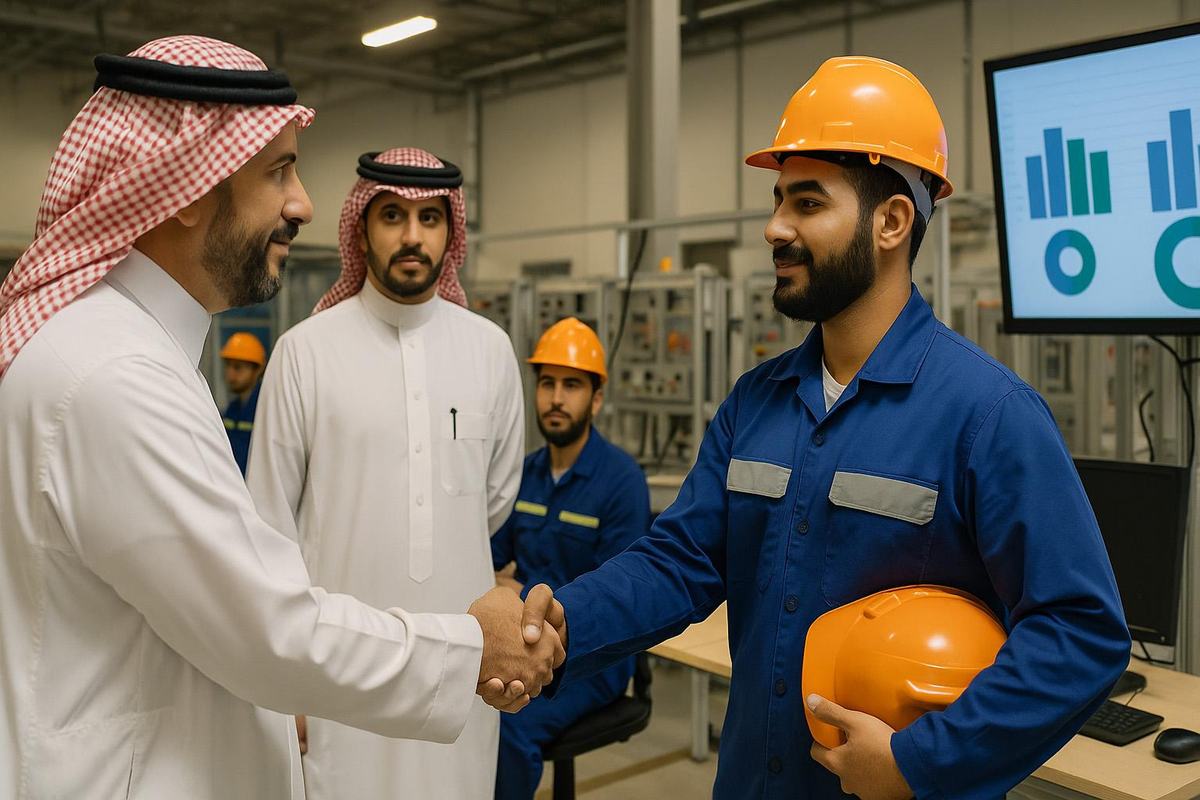

Analytical Reading of the ‘Electronics and Home Appliances Institute’ Experience
Executive Summary
- The Dilemma: 60% of graduates in technical disciplines do not find jobs matching their skills (Statistics Authority, 2024).
- The Solution: A non-profit training incubator operated through a clearly defined tripartite partnership: specialized training entity + incentivized funding entity + companies employing participating in the curriculum.
- The Result: In the home appliance sector, 100% of Electronics Institute graduates were employed within 30 days, and the turnover rate dropped to less than 20% in the first year of work.
1. Market Background: The ‘Manufacturer – Institute – Fund’ Gap
The Saudi manufacturing capacity for home appliances has doubled 1.8× in five years, while the number of qualified Saudi technicians has only increased 1.1×. The gap translates to:
Key Indicator | Factories | Result
Localization in technical jobs | 32% | High reliance on foreign labor
Technician turnover rate | 28% annually | Loss of productive knowledge
Job replacement time | 3 months | Stopping lines for certain products
2. Architecture of the Tripartite Partnership
+-------------------------+
| Human Resources Development Fund |←— Material incentives conditional on employment
| Hadaf |
+-------------+-----------+
|
| Funding 75% of the training costs
+-------------v-----------+
| Electronics Institute |—— Curriculum design in collaboration with
| (Non-profit training entity) | the companies
+-------------+-----------+
|
| Pre-employment contracts + Trainers
+-------------v-----------+
| Employing Companies |
| (29 Home Appliance Factories) |
+-------------------------+
Governance Principle: No support from ‘Hadaf’ is owed until the graduate is actually employed, requiring the parties to be accountable for the result, not the activity.
3. Program Design Journey According to Factory Needs
Step | What Happens Inside the Institute | What the Factory Receives
Job Analysis | Interview with the maintenance supervisor to identify 12 core skills | Accurate job description
Curriculum Building | Aligning 60% standard content + 40% brand-specific units | Content matching the production line
Simulation | Training devices simulating targeted refrigerators or air conditioners | Reducing transition time from the institute to the production line
Real-time Assessment | A digital performance dashboard sent weekly | Ability to discard unsuitable candidates before hiring
Employment | Signing the contract in the last week | Technician ready with 90% efficiency
4. Case Study in Numbers – ‘Cool Tech’ Air Conditioning Company
Indicator | Before partnership (2020) | After first batch (2024)
Localization rate in assembly line | 26% | 68%
Average replacement time | 86 days | 21 days
Cost of operational error* | 1.9% of product value | 0.6%
Job turnover rate (12 months) | 31% | 18%
* Includes rework and waste resulting from technical errors.
A linear chart showing the gradual decrease in errors versus productivity improvement is available for editorial inclusion.
5. Three Practical Lessons
- Shared content provides 40% of development costs: Combining core content (safety, electricity, control) with specialized units for each factory reduces the need to design a separate curriculum from scratch.
- Impact-linked funding reduces waste: The fund only pays if employment is achieved, thus eliminating the phenomenon of “full seats without jobs.”
- Factory-led field training reduces job turnover: When trainees spend 25% of their time inside the factory before graduation, integration becomes easier and loyalty to the place increases.
6. Strategic Recommendations
Entity | Action | Time Horizon
Ministry of Industry | Adopt a “Tripartite Training Requirement” as an incentive for obtaining licenses for expanding new lines | 12 months
Non-profit institutes | Establish a “Business Development” unit to negotiate with factories before designing any program | Immediate
Fund | Expand indicators to include “Average First Year Salary” as a support condition | 24 months
And let’s not forget that:
Market eyes today are on investing in automation equipment and artificial intelligence, but the Electronics Institute reminds everyone of a simpler fact: No value in technology without a trained human. The tripartite partnership that brings together training, funding, and employment ensures that human capital is ready before the factory wheels turn.
If we want to enhance the competitiveness of our industries, let’s start from here: a compatible curriculum – conditional funding – pre-employment contract. This recipe has succeeded in home appliances… and awaits someone to generalize it to other sectors.

Comments (3)
No comments yet. Be the first to comment!