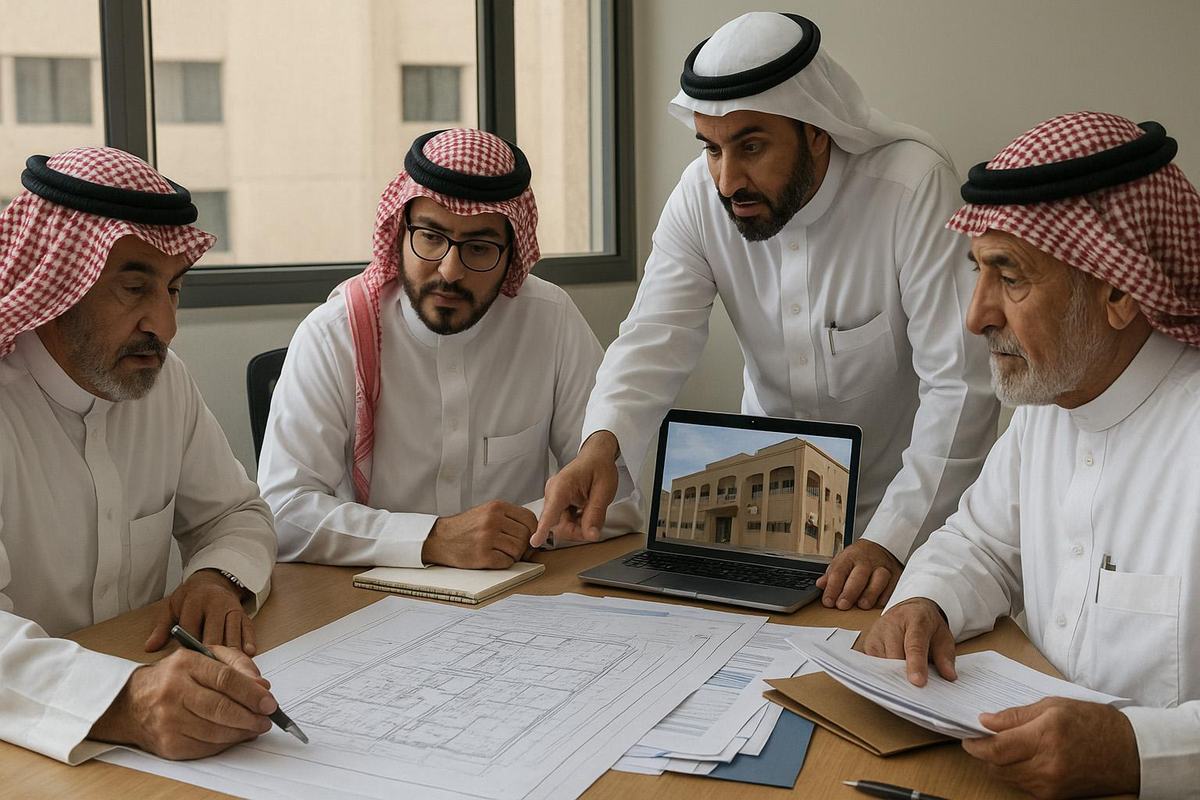

Gap Begins in the Fifth Year
When Taybah City for Special Education opened in Medina (11 buildings on 50,000 m²), the construction cost of 86 million riyals was covered by a joint foundational grant (granting body + association + Ministry of Education). However, the financial offer analysis at the forum revealed that annual maintenance costs are 2.8 million riyals, equivalent to 3.2% of the asset value; with inflation in energy and service prices, this rate could rise to 4.5% after five years.
The problem: foundational grants are disbursed in a lump sum, while concrete assets continue to “bleed” every year. If a sustainable income source is not allocated for them, they turn from a service driver into a burden that swallows up the program's budget.
The “Maintenance Endowment” Model Adopted by the Endowment Authority
Item | Implementation Details | Tangible Impact (2024)
Initial Capital | 15 million riyals from the Endowment Authority + Taybah Association contribution of 3 million | The capital is invested in a low-risk real estate portfolio
Distribution Policy | Spending 4% of the average value of the moving portfolio for the past three years | Covered 95% of maintenance expenses in 2024
Governance Condition | 30% of the returns are only released after the center receives a ⭐⭐⭐ quality rating from “Masar” | Linking funding to performance improvement, not just spending
Attached Emergency Fund | 1.5% of the return is carried over annually until it reaches 10% of the asset cost | Emergency maintenance for cooling units in Summer 2023 without urgent donation requests
“5-7 %” Safety Equation
- 5% of the asset value: It is recommended to allocate annually for the maintenance of modern educational buildings (first 10 years).
- 7%: for buildings that have surpassed a decade or operate in harsh environments (like the heat in Taybah).
- Any maintenance initiative below this percentage warns of erosion that will double cumulative costs after the tenth year.
Cash Simulation for Maintenance After the Fifth Year (Medium-sized Center)
Item | “Grant without Endowment” Scenario | “Maintenance Endowment” Scenario
Average Annual Maintenance Spending | 2 million r | 2 million r
Source of Funding | 100% from program revenues and periodic grants | 75% from endowment returns + 25% from programs
Effect on Program Budget | -18% (reducing acceptance capacity by 40 seats) | -3% only
Cash Flow Risk | High (every 3 years) | Low (covered by the emergency fund)
Steps to Establish a “Maintenance Endowment” in Your Association Within 12 Months
Phase | Duration | Main Actions
1. Assessment of Building Asset | 1 Month | Asset inventory, engineering report, estimation of annual maintenance cost × 15 years
2. Identify Funding Gap | 2 Weeks | Apply the 5-7% equation and extract the target number
3. Framework Agreement with the Endowment Authority or Partner Endower | 2 Months | Determine capital, investment policy, and joint oversight board
4. Launch “Maintenance Endowment” Subscription Campaign | 3 Months | Address local businessmen and link donations to the name of the hall or lab
5. Invest Capital | Concurrent | Diversify portfolio (property–sukuk–murabaha) with a net return ≥ 5%
6. Activate Performance Condition | After 1 Year | Link spending to star quality rating or capacity utilization index
7. Annual Review | Ongoing | Financial audit + engineering report + update maintenance plan
Governance Recommendations for the Nonprofit Sector
- Make a “Funded Maintenance Plan” a requirement in every new construction project; no financial reliance without a documented sustainability model.
- Establish an index for the “true cost of the program” that includes the share of maintenance and depreciation, to avoid the illusion of surplus.
- Include a representative of the granting body in the oversight board to ensure transparency in moving and using returns.
- Activate a separate emergency fund equivalent to 10% of the asset value over ten years.
Conclusion
Integrating endowment capital with performance quality conditions - as in the case of “Taybah” - transformed the burden of maintenance from a draining factor to an enabling factor that solidifies partner trust and opens the door for new expansions without concern for the “fifth year”. For educational associations, maintenance endowment is not a financial luxury but an insurance policy for the sustainability of their educational impact for decades to come.

Comments (3)
No comments yet. Be the first to comment!