
The Problem Faced by Workers in the Sector
- Repeated Programs for Productive Families: Sewing courses, home cooking workshops… but the income stops when the grant ends.
- Absence of the Industrial Loop: Quality standards, licenses, packaging, and supply chains remain out of reach for families.
- Poor Marketing: Reaching markets outside the neighborhood or city costs more than the expected profits.
The Social Development Bank's Path: Four Consecutive Stages
Stage | What the bank does | Result for families and associations
1 – Agreement | Signing operational funding contracts with associations (90 agreements / 200 million riyals) | A clear commitment to impact indicators (number of beneficiaries – monthly income)
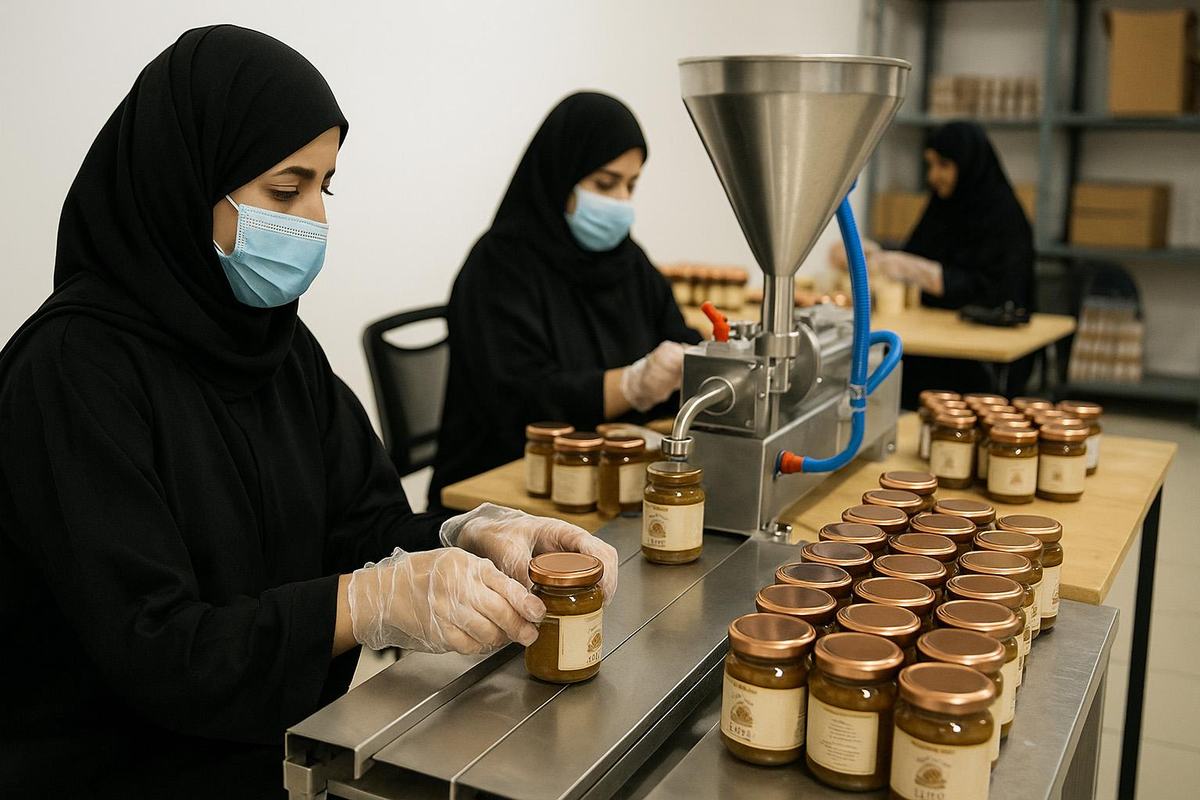
2 – Specialized Lab | Equipping 30 craft labs and 10 food labs within the associations' premises | A production environment that meets food safety or craft requirements
3 – Mini Production Line | Training families on managing a production corner (equipment, standardizing recipes, cost calculation) | Transitioning from “home recipe” to “standard product”
4 – Major Retail Outlet | A special ticket for participation in the Global Village in Dubai, the Boulevard, or the Dar Market | A wide market + bulk contracts + success stories ready for marketing
Performance Indicators (Before/After)
Indicator | Before the program | After 12 months of operation
Average monthly family income | 1,050 ﷼ | 4,300 ﷼
Number of products approved by the food authority | 0 | 118 products
Families that transitioned from “individual activity” to “commercial entity” | 3% | 26%
Bulk contracts signed (kiosks – provision stores) | 4 | 37
Source: Social Development Bank Indicator Dashboard – May 2025 update.
What Makes the Model Different From Previous Initiatives?
- Funding Based on Impact: The second grant disbursement is only made after families achieve a minimum sales threshold.
- Vertical Integration: Step by step transition for families from home production to a semi-industrial production line within the association's lab.
- External Market Contracts: Linking the product to mass markets (Global Village = 8.2 million visitors) makes the income non-seasonal.
- Collective Learning Curve: Families work in a single line, exchanging experience and supplies, reducing wasted time on individual trials.
Transferable Lessons for Your Nonprofit Association
Step | What You Actually Need | Potential Source of Funding or Partner
Product Feasibility Analysis | Market survey – cost accounting | “Bader” programs – local universities
Establishing a Mini Lab | A space of 60 m² + health lines | Grants from the Endowment Authority / local waqfs
Product Quality Certification | Food certificate or industrial mark | Food and Drug Authority – 'Madinah'
External Market Contract | Agreement with a public event | Entertainment Authority – Chambers of Commerce
A Word for Those Working in Nonprofit Training
The Social Development Bank model demonstrates that integration (funding + infrastructure + market) is more important than the amount of the grant itself. If the four links in the chain are available, craft work becomes a long-term social investment.
The transition from “productive families” to “mini craft factory” is not a luxury; it is the distinguishing factor between support that ends with the completion of the course and income that funds both the family and the association alike.

Comments (3)
No comments yet. Be the first to comment!