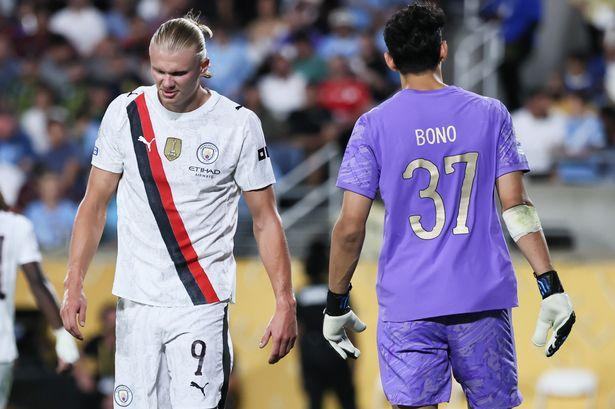

Sami Al-Jaber rides off into the sunset, Cristiano Ronaldo dribbles, and 75,000 fans cheer… That was the evening of January 21, 2008, when Al Hilal lit up King Fahd Stadium in farewell to its legend and recorded a historic victory over Manchester United (3-2). Years have passed, and the reality has changed: Ronaldo himself is now playing in the Saudi league, and Al Hilal defeats European champion Manchester City in the Club World Cup. But the most significant event may take place off the white lines; in the back hallways where the idea of transforming clubs into endowment incubators that channel the benefits of “Champions League” into community veins is woven.
1. A financial explosion unseen in the stands before
Since the Public Investment Fund (PIF) injected its investments in June 2023 – acquiring 75% of the shares of Al Hilal, Al Nassr, Al Ittihad, and Al Ahli – the language of finances has changed:
Club | Total Revenues 23-24 | Commercial Growth | Sponsorships | Net Income/Loss
Al Hilal | 1.09 billion riyals | +105% | 440 million | +33.3 million
Al Ittihad | — | +243% | — | —
Al Ahli | 342 million | +222% | — | –113 million
Al Nassr | 615 million | +71% | — | –39 million
300% growth in sponsorships for Saudi clubs in just two seasons (from 88 million to 328 million) according to the Ministry of Sports; figures that surpass the combined growth rate of the top five European leagues during the same period.
2. The ROI speaks in the language of fan competition
Bloomberg Al-Sharq calculates it by long-term yields: every riyal injected by the business partner into the logos of Al Hilal or Al Ittihad shirts translates into spiritual and material gains beneath the profit line. However, the Saudi sponsorship market – with its rising value expected to reach 1.8 billion by 2027 – has started to approach a “saturation curve.” Here, a new option emerges that goes beyond mere sponsorship: the public sports endowment.
3. The “sports endowment” model… a ball rolling towards sustainability
- Allocating a fixed percentage from key sponsorship contracts (for example, 2% from the partnership between “Riyadh Bank – Al Hilal” valued at 60 million annually).
- Establishing an independent endowment fund managed by a specialized charitable association according to the regulations set by the endowment authority.
- Integrated public marketing: every season ticket carries the phrase “You contributed one riyal to the Al Hilal Endowment for Talented Students.”
- Transparent governance through annual reports broadcasted via the club's digital platforms.
With an average investment performance of 5% annually, an initial capital of 100 million riyals could generate 5 million riyals in stable charitable returns every season - enough to support 2,000 students or fund 50 small football schools in low-income neighborhoods.
4. Why does everyone win?
Party | Gains
Club | Enhancing national and community image, attracting sponsors looking for an added “responsibility brand,” reducing reputation risks.
Business partner | A marketing trade-off with a humanitarian dimension, and ready CSR points for annual reporting.
Charitable associations | A channel for stable public funding, and a sports brand provides it with unparalleled exposure compared to advertisements.
Public | Converts emotional loyalty into “social investment,” and feels that every cheer in the stands has an impact after the final whistle.
National economy | Increasing the contribution of sports to GDP and directly linking it to the goals of Vision 2030 for social development.
5. Immediately executable examples
- Salem Al-Dosari Endowment for Quran Memorization – Funding circles in neighborhoods of Riyadh, personally supported by the owner of the “Century Goal.”
- Cristiano Ronaldo Endowment for Digital Innovation – Scholarships for Saudi youth in data science, with the CR7 logo inside university labs.
- Al Ittihad Club Endowment for Restoring Public Playgrounds in Jeddah – Engineering supervision by the club's partner (Roshan) linking real estate with sports and community.
6. The regulatory environment is ready
The Ministry of Sports obligated non-profit sports institutions – according to a decision made in July 2023 – to register on governance platforms and submit financial reports, which means the path is paved for establishing endowments under the identity of clubs without regulatory obstacles, and in automatic partnership with the non-profit sector subject to supervision by the National Center for the Development of the Non-Profit Sector and the General Authority for Endowments.
7. An unending whistle
From the penalty kick with which Sami Al-Jaber bid farewell to the fans to Salem Al-Dosari's ball that stunned Emiliano Martinez in Doha, and now to the idea of the “Al Hilal Endowment Fund”... a journey of Saudi football that has learned to score on the pitch, and can now score in the records of charity.
Will we soon see an electronic scoreboard displaying:
Al Hilal 1 × 0 Hunger, Al Ittihad 2 × 0 Unemployment, Al Nassr 3 × 0 Illiteracy?
Only then will we discover that the greatest titles may be lifted outside the stands, and that true glory begins when the stadium is closed and the endowment books are opened.
The key sources on which the article relied
- News “Ministry of Sports obliges non-profit sports institutions to governance and transparency requirements” issued in July 2023 on the site Ma'al Newspaper. (maaal.com)
- Report “Clubs owned by the Public Investment Fund: Rising commercial revenues for Al Ittihad 243%, Al Ahli 222%, Al Hilal 105%” (March 7, 2025) by Mamdouh Al-Yahya – Ma'al Newspaper. (maaal.com)
- Coverage from Agence France-Presse (published via Al Arabiya) on Sami Al-Jaber's farewell match: “Al Hilal defeats Manchester United 3-2” (January 21, 2008). (alarabiya.net)

Comments (1)
No comments yet. Be the first to comment!