
How Does Early Intervention Reduce Costs and Improve Learning Outcomes?
(Fully summarized from the discussions of the Non-Profit Sector Forum 2025 and the experiences of 'City of Taybah' and 'Qudrat Schools')
The Early Childhood Gap: Where Do We Stand Today?
Ministry of Education Indicator (2024) | Number | Target 2030
Children enrolled in intellectual kindergartens (government + non-profit) | 406,000 (36.7% of the age group) | 90%
Registered specialized non-profit centers | 103 | — (Expansion is open)
The main gap is not just in seats; it is also in curriculum quality and the classroom's ability to integrate the child later into general education.
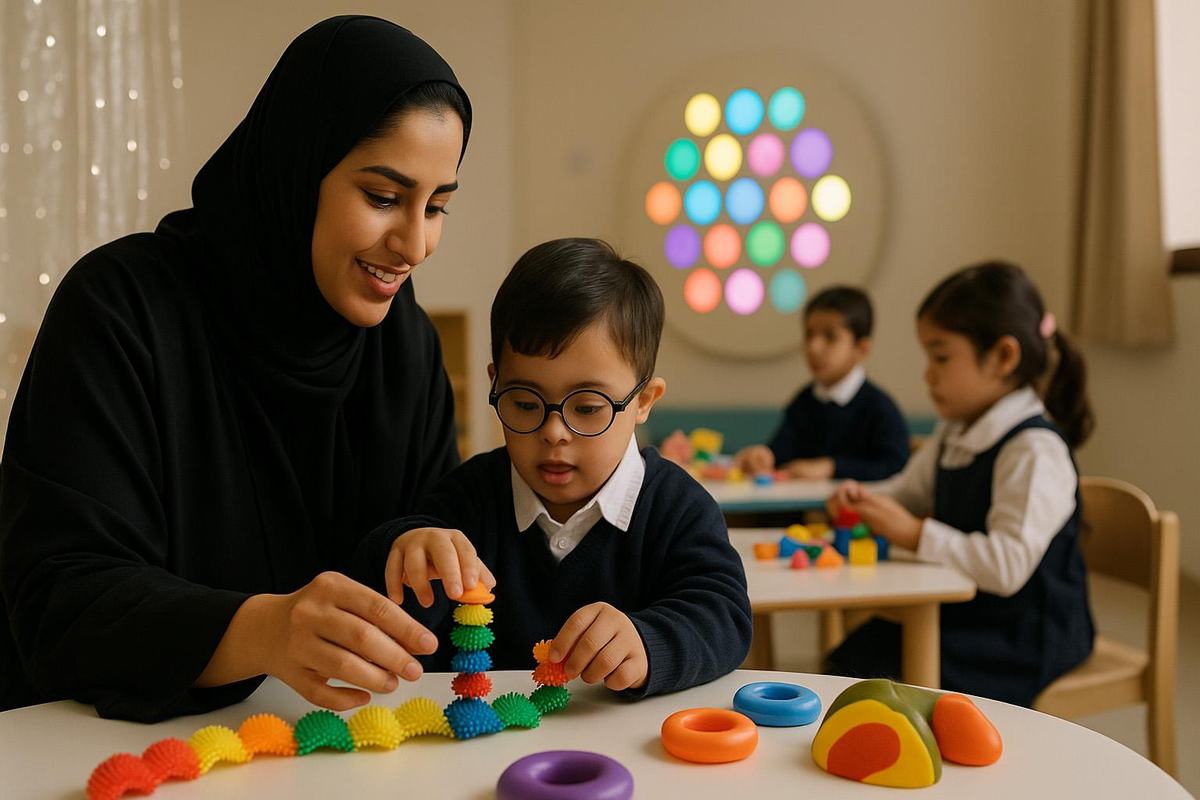
Integrated Classroom Engineering: Taybah/Qudrat Model
Design Element | Specification | Expected Impact
Student-to-Teacher Ratio | 5:1 | Individualized teaching frequency – behavior management
Multi-Sensory Room | Dimming lights, ambient sounds | Reduced distraction by 28% (Qudrat experience)
Home Follow-Up Application | Short exercise videos for parents | Increased adherence to plans by 19%
Activity Schedule (posters/images) | Visual schedule inside the classroom | Enhanced independence by 14%
Before/After Indicators (36 months)
Indicator | Before Intervention | After Graduation to First Grade | Source
Receptive Language Skill (PLS-5 Scale) | 48 points | 69 points | City of Taybah
Self-Injurious Behaviors (Frequency/Hour) | 1.7 | 0.4 | Qudrat Schools
Rehabilitation Cost in Primary Stage* | 27,000 SAR/Student | 19,000 SAR/Student | Joint Health/Education Analysis
Partial Integration Rate in Regular Class | 22% | 73% | Qudrat
* Includes shadow teacher and speech and occupational therapy sessions.
Accreditation and Quality Mechanism
- Specification of “Saudi Early Childhood Environment” (developed in partnership with Al-Muhaidib Foundation + Standards Authority): Defines classroom dimensions, evaluation tools, and safety requirements.
- “Masar” Visit Every Two Years: Five-star accreditation connects Ministry of Education funding to quality level.
- “Early Skills Management Dashboard”: Live data for language and behavior submitted to Masar Center and compared to national standards.
Intelligent Expansion Map for Associations
Stage | Expansion Condition | Possible Incentives
1 – Local | Rating of ⭐⭐⭐ at least – Trained Staff | Sensory room setup grant from the Endowments Authority
2 – Regional | Masar accreditation + Health Partner | Reduced rent incentive from 'Madinah' or municipality
3 – Mobile | Impact record for three years | Early intervention bus funded by industrial sector CSR
Practical Recommendations for Non-Profit Sector Workers
- Start small and specialized: One intellectual class with a standard environment is better than a large building without quality.
- Sign a memorandum with the health gathering from day one; early medical diagnosis is a fundamental requirement for educational success.
- Integrate your measurement dashboard with “Masar” to avoid resubmitting data and to receive early alerts for any decline in indicators.
- Invest in family training; 30% of the child's progress in Taybah was attributed to home exercises.
Conclusion
Early intervention in non-profit intellectual kindergartens reduced subsequent rehabilitation costs by about a third and increased partial integration to over 70%. The secret is not in the number of classes, but in the quality of design, integrated medical-educational diagnosis, and linking support with live data. The journey from care to empowerment begins with a small classroom... if built on a standard and applied with a clear roadmap.

Comments (3)
No comments yet. Be the first to comment!