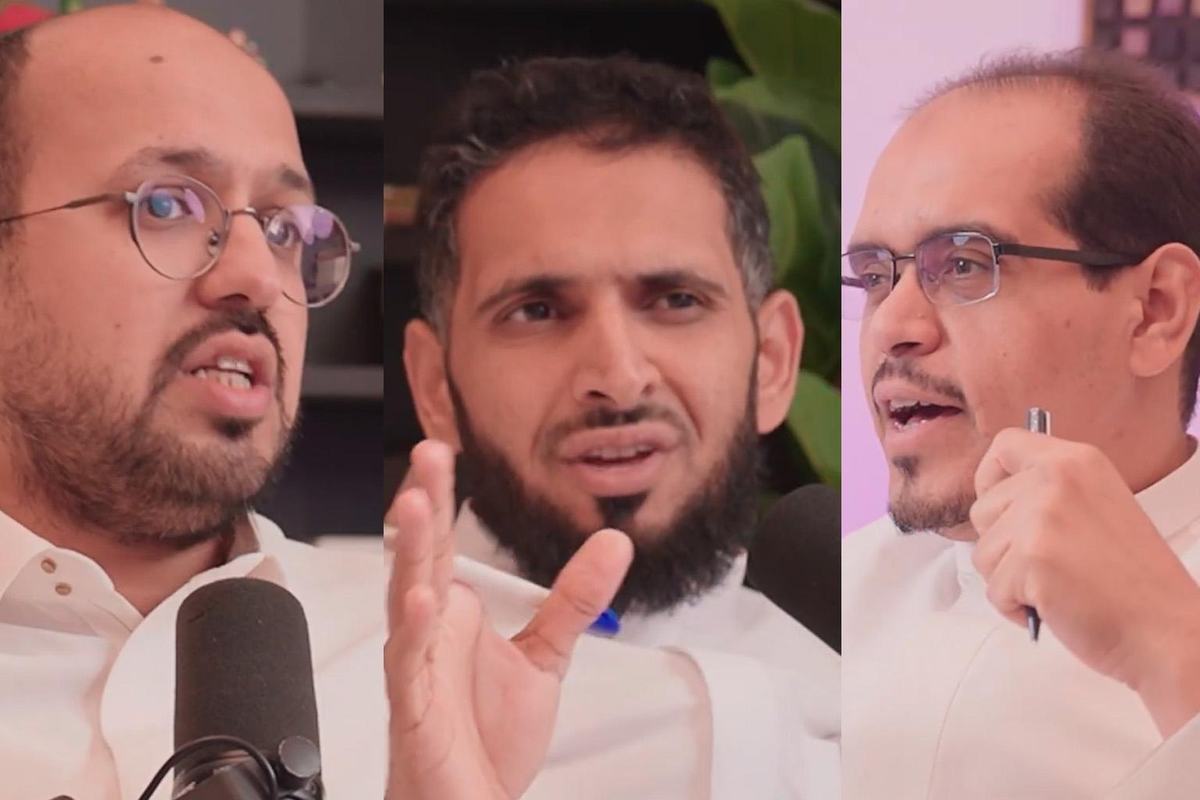

The episode does not merely recount impressions of the forum but strives to make it a turning point in understanding the role of the Saudi sector, and to reframe the big questions: Who are we? To what project do we belong? What does it mean to be part of a global scene called Beyond Profit?
The episode The Sector's Story revolves around the Beyond Profit 2025 ‘Beyond Profit’ forum organized by the National Center for Non-Profit Sector Development, at a time when the discourse surrounding the sector is transitioning from a language of care and benevolence to one of development, sustainability, and impact.
This reading attempts to analyze the episode as a cognitive and media product at the same time: What has it successfully achieved? What spaces has it left open for development in future seasons?
The Episode as a 'Mirror' for the Sector's Transformation
What distinguishes this episode is that it does not treat the forum as a “passed event,” but as a milestone in the history of the Saudi non-profit sector. Hilal Al-Qurashi clearly states that the sector will not be the same after the forum, positioning it within a deeper transformation that began with the establishment of the National Center and is now accelerating under the umbrella of Vision 2030.
At the level of overall structure, the episode presents three interlinked layers:
A Lived Personal Experience:
- Hilal's hesitation to attend and then his admiration.
- Hamid's sense of pride as he sees the sector’s name on screens and roads.
- Muhammad's acknowledgment that he usually “escapes” from traditional forums, then his regret for not attending this particular forum.
Conceptual Deconstruction of the Title and Identity:
- An extensive discussion of the meaning of Beyond Profit and liberating the sector from the clutter of labels: charitable, non-profit, developmental... in favor of a broader concept that encompasses all that operates outside the logic of direct financial profit but creates developmental and economic value.
Critique of the Forum Culture Itself:
- A clear skepticism regarding the effectiveness of many past forums (padding, repetitive presentations, lack of renewal).
- A call for the development of the traditional conference model towards more interactive formats (discussion circles, field visits, formats resembling hackathons, caravans traveling through regions...).
In this sense, the episode is not “media coverage,” but rather a thoughtful – professional dialogue that seeks to place the forum within a larger narrative entitled: The Transformation of the Saudi Sector from Philanthropy to Development.
Strengths in the Episode's Treatment
1. Transitioning from Language of Care to Comprehensive Sustainability
The episode clearly dedicates itself to the idea that sustainability is not merely about sustainable funding, but:
- Environmental sustainability
- Human resources sustainability
- Social and economic sustainability
The invocation of Hamad Al-Kaltham's pitch at the forum, and linking it to concepts like ESG, shows an awareness that the sector is entering the realm of institutional sustainability beyond just “securing next year’s budget.”
To a deeper question: “How do we design a model that does not collapse at the first crisis nor consumes the people and places it serves?”
The value of this proposition is that it moves the listener from the question: “How do we secure our donations?”
2. Liberating the Forum's Name from the Superficiality of Translation
Muhammad Al-Mutairi's discussion on the title Beyond Profit goes beyond the linguistic interpretation, placing it within the framework of:
“All practices that are not aimed at financial profit, regardless of their form, are fundamentally developmental initiatives.”
This reading helps to:
- Break the barrier between the “non-profit sector” and the “responsible commercial sector.”
- Introduce the well-regulated and fair commercial work into the heart of the developmental discussion, not in the margins of “social responsibility.”
This point specifically is considered one of the strongest additions of the episode; redefining “the greatest developmental work” as possibly being a successful and fair business project, not just a seasonal donation campaign.
3. Highlighting the Global Dimension without Losing Local Sensibility
The episode astutely captures a sensitive equation:
- On one hand: Praise for foreign participation, in the prevalent English language, and the center's attempt to present a different Saudi image to the world.
- On the other hand: Clear reservations from Muhammad about “borrowing innovation” from abroad, advocating for the authenticity of the local experience and the necessity for innovation to emerge from the realities of the community rather than replicating best practices.
This healthy tension between globalization and localism, if well-invested, can create a Saudi school of non-profit work, not just an improved version of Western models.
4. Restoring the Value of Networking and Relationships
Hamid Al-Dhiabi reminds us that the greatest gains from forums often take place in the “margins” rather than on the platform:
- Side meetings.
- The birth of partnerships.
- Renewed relationships of individuals who distanced themselves from the sector and were drawn back by the forum.
This analysis is important because it restores balance to expectations from any forum: it is not always required to walk away with a dazzling scientific paper; rather, it is essential to understand that a large part of the value of the sector is created in networks, relationships, and mutual trust.
Critical Comments on the Content Level
Despite the strength of the idea and the depth of many contributions, there are still observations that could enrich future episodes and increase their reference value:
1. Absence of Comparative Numbers Despite the Density of Concepts
The episode is filled with concepts (sustainability, ESG, Beyond Profit, local innovation, the role of companies...) but is almost devoid of:
- Numbers about the contribution of the non-profit sector to the economies of G20 or G7 countries.
- Comparative indicators about impact investment, or volunteering, or the sector's contribution to GDP.
- Any percentages or statistics linking the discussion of “post-philanthropy” to broader global transformations.
For example, the forum could have been linked to global figures showing that what is happening in Saudi Arabia is not an exception, but part of an international movement towards impact economy.
Although the spirit of the discussion suggests that the speakers possess this depth, the absence of numerical references detracts from the episode's weight in front of an audience of economic leaders and policymakers.
2. Fluctuation in the Rhythm Between Depth and Friendly Rambling
One of the podcast's strengths is its human closeness and the spirit of humor among the trio, but in this particular episode:
- There are long segments of humor and side stories that may distract listeners who are not accustomed to the trio's style.
- The transition between topics occurs sometimes with rapid jumps: from analyzing the forum to old stories about gatherings in the Eastern Province, to personal anecdotes, and then back to the main thread.
Future episodes may need rhythm regulation stations: a focused segment every 10–15 minutes summarizing what has been said and bringing the listener back to the main topic.
This style is natural in a conversational podcast, but it reduces the possibility of using the episode as a professional reference for those who want to quote it in work papers or official presentations.
3. Recommendations Not Wrapped in a Clear Roadmap
The episode presents powerful ideas that could easily turn into a “work agenda” for the sector, such as:
- Redesigning forums to be platforms of innovation rather than platforms of discourse.
- Transitioning from giving a fish to teaching how to make a fishing rod, and then further beyond that.
- Encouraging companies to view fair business as the greatest developmental work.
- Engaging the post-2000 generation (Gen Z) in shaping the future of the sector.
However, these ideas often remain in the form of strong thoughts that are not formulated into:
- Practical steps.
- Specific questions for the national center or funding entities.
- Self-commitments announced by the trio (e.g., what will The Sector's Story and The Third Bank do after this forum?).
Turning these ideas into “ten questions for the future” or “five messages after the forum” would have made the episode a document more conducive to quoting and employment.
4. Prominent Presence of the Trio of Hosts and Absence of Other Voices
The episode entirely relies on the perspectives of:
- Hilal Al-Qurashi
- Hamid Al-Dhiabi
- Muhammad Al-Mutairi
These are indeed rich perspectives, but the question remains open:
How could the episode have been enriched if a fourth or fifth voice was included, even through a short recording?
- A manager of a small association from outside Riyadh.
- A young person from Gen Z working or volunteering in the sector.
- Or even a voice from the national center commenting on what has been said.
Such inclusion would have practically embodied the idea of diversity that the speakers themselves advocate for.
The Episode as a Call to Redesign the 'Sector Forum' Itself
It is noteworthy that the criticism directed by Muhammad, Hamid, and Hilal towards traditional forums can also be read as a call to redesign our dialogues within the entire sector, including podcasts:
- It is not enough to have luxurious halls and beautiful applications; what is more important is to innovate new formats for collective thinking.
- It is not enough to repeat global terminologies; what matters more is to produce an authentic Saudi experience in sustainability and innovation.
- It is not enough to critique philanthropy; what matters more is to build practical models to transform the “needy” into a productive economic agent equipped with tools.
In this sense, this episode can be considered a first draft of an incomplete manifesto on “post-philanthropy” in the Saudi sector, awaiting formulation into more structured texts, working papers, and joint projects between:
- The Sector's Story
- The Third Bank
- And the system of the national center and its partners.
Towards a More Mature Season... From Story to Industry
Despite the critical notes, the episode remains an advanced step in the path of The Sector's Story; because it:
- Captures a pivotal event (the Beyond Profit forum) and transforms it into material for thought, not just coverage.
- Dares to criticize the traditional forum model without falling into the trap of negativity or skepticism.
- Links between religious language (zakat, transforming the poor from consumers of charity to contributors to the economy) and modern economic language (sustainability, impact investment, ESG) in a rare manner in Arabic content.
The challenge in the upcoming seasons is to turn this level of discourse into:
- More organized episodes in the sequence of ideas.
- A greater presence of numbers and international comparisons.
- Clearer integration between the podcast and knowledge platforms like The Third Bank (accompanying PDF files, infographics, suggested readings).
If the trio succeeds in this, then The Sector's Story will not just be a podcast commenting on transformations, but a tool for shaping them… just as the Beyond Profit forum seeks to be more than a beautiful slogan in a luxurious hall.

Comments (2)
No comments yet. Be the first to comment!