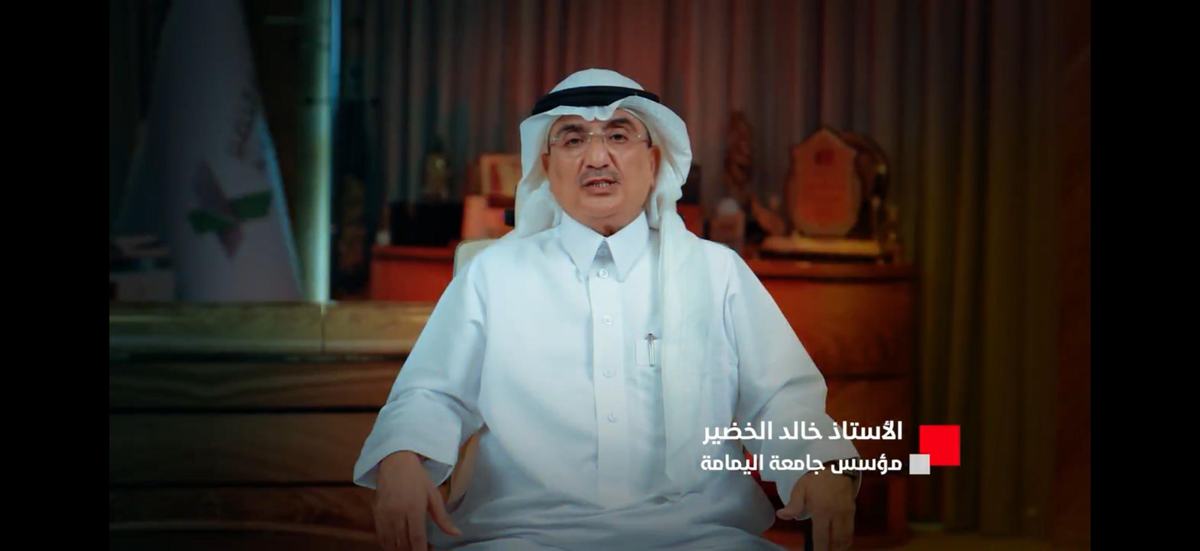

In a special session during the "TEDx Endowments at King Saud University" event held today, Saturday, May 16, 2026, in the capital Riyadh, Mr. Khalid bin Muhammad Al-Khudir, Chairman of the Board of Trustees of Al-Yamamah University, presented an inspiring experience that redefined the concept of "waqf" in community awareness. Going beyond the stereotypical image of waqf as mere "properties and buildings", Al-Khudir shared a family and institutional story spanning a century that proves that waqf can be an economic driver and a sustainable investment that shapes generations.
The Spark of Beginning: The Passion for Knowledge Challenges Circumstances
Al-Khudir began his speech with a tribute to his late father, Sheikh Muhammad bin Ibrahim Al-Khudir (may God have mercy on him), who lived a century devoted to education.
The story began in the Riyadh Al-Khobar district of Qassim, where the visit of a "learned judge" to the family council inspired young Muhammad Al-Khudir to seek knowledge.
This journey led him to Riyadh, then to work in state farms in Al-Kharj, reaching Aramco in Dhahran during World War II.
There, he not only worked with American engineers but established an evening school to teach and train Saudi workers in English. This passion later culminated in his condition of building a school for farmers' children in Al-Kharj as a prerequisite for accepting a translator position, thus laying the first bricks of his educational project.
Pioneering Girls' Education: Risking for the Community
In 1370 AH, Sheikh Muhammad Al-Khudir noticed the absence of formal schools for girls in Riyadh, so he took the initiative to establish "Model Education Schools" through personal efforts and self-funding that burdened him financially.
Despite the challenges, the project continued until the establishment of the Presidency for Girls' Education in 1380 AH.
This initiative later received government support covering 50% of costs, along with an annual grant of 12,000 riyals from Aramco for five years, marking a major turning point in the schools' journey.
The Waqf as a Strategic Partner (by Generations, Not Profits)
Mr. Khalid Al-Khudir addressed the massive institutional transformation, where the Model Education Schools evolved into "The National Company for Education", a public joint stock company that currently includes:
* 40,000 male and female students.
* 5,000 male and female teachers.
* 25 educational complexes across the Kingdom.
In an unprecedented move that reflects modern waqf thinking, "Mohammed Al-Khudir Endowment" owns 30% of the shares of this company. Al-Khudir explained that the family treats the waqf as if it were "one of the heirs", ensuring its sustainable growth and its size multiplication with the company's expansion, thus becoming a strategic partner in the development journey.
The Community Impact: Investing in the Peripheries
Al-Khudir emphasized that educational endowments should focus on making a difference in peripheral areas that need advanced educational infrastructure. Achievements of this approach included:
* Building and completing stalled or rented public school projects in collaboration with the Ministry of Education.
* Establishing "The Educational Waqf" which resulted in 70 educational complexes valued at 500 million riyals over four years.
* Launching an educational portfolio in cooperation with the "Ehsan" platform, which has collected 450 million riyals so far before its actual operation.
From Riyadh Al-Khobar to the World
Al-Khudir concluded his participation by discussing the direct impact on his father's birthplace, Riyadh Al-Khobar district, which recently joined the UNESCO Learning Cities Network. These efforts culminated in establishing a model school for gifted students, characterized by:
* A limited capacity to ensure quality (120 male and 120 female students, with a maximum of 20 students per class).
* A partnership with the American "Interlink" Foundation to develop English language programs and train staff.
* Providing all school supplies and healthy nutrition to ensure an ideal educational environment.
Today, the ambitions of the children of this small district have changed; they no longer limit themselves to basic education but have exceeded that to compete for admission to the best universities in the world. This model demonstrates that "educational waqf" can bridge the gap between a small village and the entire world.

Comments (2)
No comments yet. Be the first to comment!