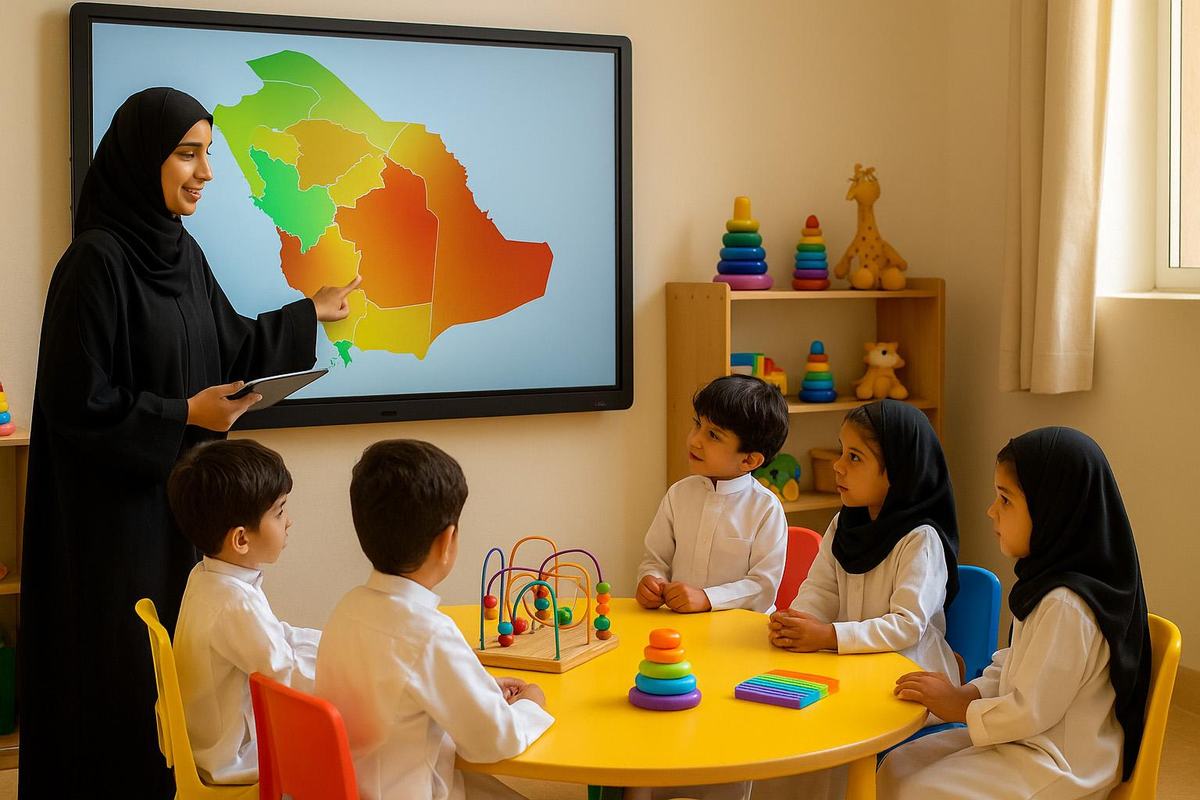

The Kingdom aims to raise children’s enrollment in early childhood education to 90% by 2030, but the current rate does not exceed 36.7%. The Early Childhood Agency's presentation confirmed that every riyal invested in the early years yields a cumulative return between 7-13% and subsequently reduces rehabilitation costs by 30%. This article explains the extent of the seat gap through a heatmap and proposes three financing models (foundational grants, social impact bonds, regional endowment funds) based on field experiences from 'Taybah City' and 'Qudrat Schools.'
Unmissable Economic Return
'Every riyal in early childhood saves three riyals in secondary education' – Excerpt from Dr. Saad Al-Harbi's remarks.
- Cumulative Return 7-13% (Cited from Heckman's curve mentioned by the speakers).
- Reduced Rehabilitation Costs by 30% (Taybah/Qudrat data: 27,000 riyals before intervention → 19,000 after).
- Increased Partial Integration to 73% in regular classes (Qudrat Schools experience).
Seat Gap Map (2024)
Data from 'SDAIA' + Ministry of Education as presented in the session
Region | Enrollment Rate in Intellectual Kindergartens | Gap Compared to Target | Note
Al-Madinah | 41% | -49 Points | Overcrowding in three peripheral neighborhoods
Northern Borders | 28% | -62 Points | Absence of specialized centers
Jazan | 30% | -60 Points | Distance of mountain villages from services
Riyadh (the capital) | 55% | -35 Points | Quality gap more than quantity
Overall Kingdom Average | 36.7% | -53.3 Points | Target of 90% requires a 2.5× increase in seats
Investment Estimate Until 2030
Item | Factor | Approximate Result
Children in Age Group (3-6) 2025 | 1,450,000 | —
Additional Seats Required to Achieve 90% | 1,450,000 × 53.3% = | ≈ 774,000
Cost of Establishing and Equipping a Seat* | 15,000 riyals | —
Total Foundational Investment | 774,000 × 15,000 | ≈ 11.6 billion riyals
* Includes sensory rooms and meets the 2024 national specification standards.
Note: The figure does not include ongoing operational costs, which are covered by contracts with the Ministry of Education following the Taybah/Qudrat model.
The Three Financing Models
4.1 – Foundational Grants for Establishment and Equipment
- Source: Endowment Authority, endowment funds, CSR of industrial companies.
- Mechanism: Two payments (70% upon engineering approval, 30% after achieving ⭐⭐⭐ rating in 'Masar').
- Advantage: Less complex, suitable for emerging associations.
4.2 – Social Impact Bonds
- Source: Development investors + conditional future government payment based on impact.
- Incentive Indicator: Achieving an integration rate ≥ 60% or reducing rehabilitation costs ≥ 25%.
- Reference Experience: Discussed as the 'America 2010' model during the session, with potential application to peripheral kindergartens.
4.3 – Regional Endowment Funds
- Oversight: Emiriate of the region + Chamber of Commerce + local association.
- Mechanism: Fixed annual revenue invested in constructing new seats.
- Advantage: Long-term sustainability ensuring maintenance of standards and alignment with population growth.
Field Lesson: Taybah and Qudrat
Criteria | Before Intervention | After | Improvement Rate
Cost of Adjustment After Operation | 15% of value | 3% | ▼ 80%
Severe Behaviors | 1.7/hour | 0.4/hour | ▼ 76%
Family Attendance for Homework Exercises | 38% | 57% | ▲ 19 points
Conclusion: Compliance with environmental specifications + implementation of a 36-week curriculum + health partnership = Measurable impact justifying investment.
Roadmap for Associations (2025-2030)
Year | Work Priority | Proposed Funding
2025 | Diagnosing the gap in each governorate – Establishing a governance council | Grant from the Endowment Authority (feasibility study)
2026 | Constructing 25% of required seats in red areas | CSR + 'Waed' program for construction financing
2027 | Launching the first social impact bond in Jazan | Development Bank + Human Resources Development Fund
2028 | Incorporating specifications in all new licenses | Contractual requirement for the Ministry of Education
2029 | Measuring the impact over five years and linking support to results | 'Masar' dashboard + financial decision-maker
2030 | Reaching 90% and transitioning to maintenance and improvement financing | Regional endowment fund
Recommendations for the Non-Profit Sector
- Link Grant Proposals to the Heat Map: Funders want a clear priority.
- Integrate Diagnostic Services within kindergartens to generate self-income covering 20-30% of operations.
- Prepare for Impact Bonds: Gather baseline data today to prove impact tomorrow.
- Collaborate with the Emirate of the Region in establishing an endowment fund to ensure sustainability post-2030.
Conclusion
Closing the 90% gap in early childhood is not just about building classrooms; it is about restructuring the financial system from traditional grants to innovative tools that link payment to impact. The figures from Taybah and Qudrat confirm that ROI can reach 13%, making early investment the smartest economic and social decision on the non-profit sector's table today.

Comments (3)
No comments yet. Be the first to comment!