
Between Two Recommendations… I Drowned in a Sea I Did Not Want to Escape!
In less than a week, I received two recommendations from two completely different personalities in character and temperament; the first from Hamad Al-Khalitham who extracts things from their depth, and the second from Mohamed Al-Mutairi who only aligns with what awakens the mind.
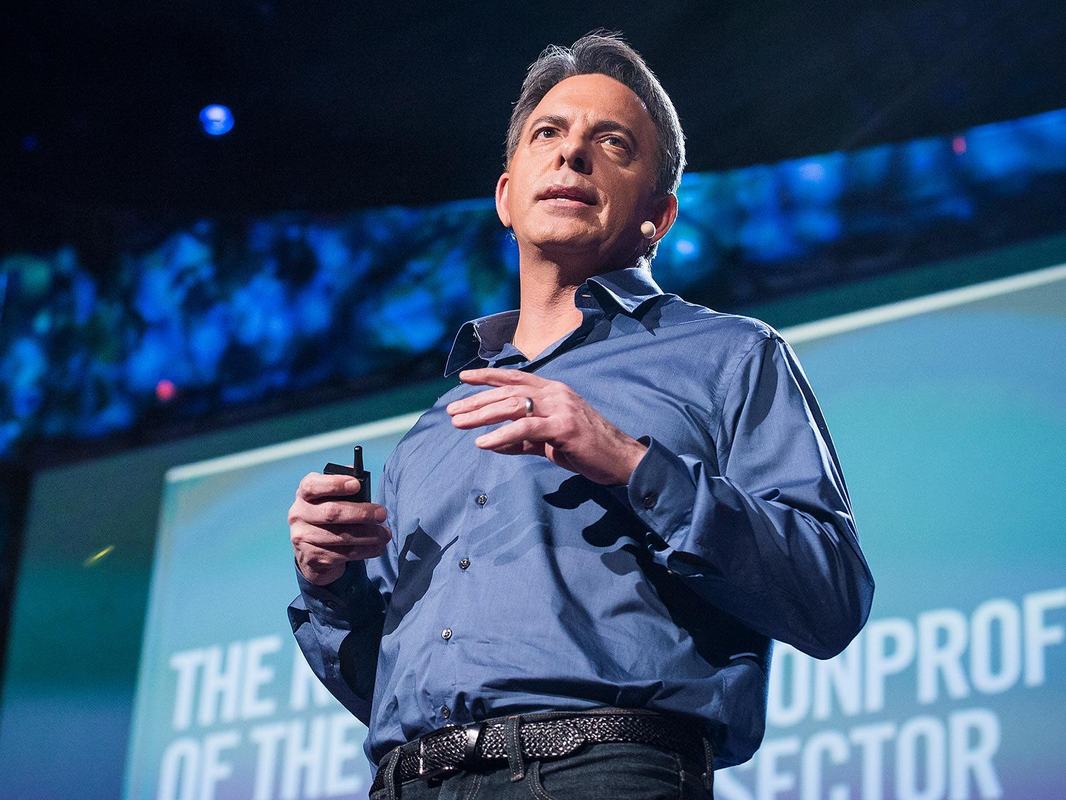
It was about a short clip on TED, but once I watched it, I was immersed in the ocean of Dan Pallotta, the one who is deeply in love with goodness and frustrated by the way it is managed.
His famous lecture "The way we think about charity is dead wrong" shook me because it not only critiques the organizational structure but also dismantles our moral convictions about charity. It is a bold call to redefine: What is charity? Who has the right to profit? And what does efficiency mean in a world that suffers from contradictions?
Charities Are Not Saints… So Why Do We Judge Them as Righteous?
Pallotta begins by discussing the deep discrimination between the for-profit and nonprofit sectors. In the corporate world, a manager is rewarded for expanding the market and increasing returns. However, in nonprofits, a manager who spends on hiring, marketing, or building the organizational system is condemned as "wasteful", even if their results are unprecedented.
— Dan Pallotta
"It's socially unacceptable to profit from alleviating people's pain, but it's fine to profit from selling what harms them"
This contradiction in moral standards has left the nonprofit sector deprived of competitive tools, constraining its vision of what true impact means.
The Trap of "Operating Costs": When Efficiency Is Slaughtered in the Name of Asceticism
Dan elaborates on the obsession with the percentage of administrative and operational costs, which has turned many nonprofits into organizationally fragile entities. Because donors and boards expect those rates to be "close to zero", organizations have:
- Avoided professional hiring.
- Refused to invest in technology.
- Shied away from marketing and experimentation.
But what is the real outcome of this forced asceticism? Organizations that are unable to scale and make a radical difference in people's lives.
Is Investing in Donations… a Sin?
Pallotta narrates the story of breast cancer fundraising campaigns that spent millions on marketing but raised hundreds of millions. This glaring example proves that spending is not the enemy of impact, but its means.
He states:
"If we invest $100,000 to raise $1 million, that is better than spending $10,000 to raise $50,000. But we reward the second because the cost of fundraising is lower… not because the return is greater!"
Shocking Numbers… Yet Logical
Dan Pallotta presents numbers that reflect the gap between what society allows the for-profit sector and what it constrains the nonprofit sector to:
- More than 140 for-profit companies exceed $1 billion in annual revenue.
- In contrast: only one nonprofit organization does that.
The reason? It's not due to a lack of important issues, but in the perspective that deprives charities of tools for expansion, investment, and growth.
In Saudi Arabia: Will We Repeat Mistakes… or Create a New Model?
Will this quantitative growth lead to qualitative impact?
The Saudi nonprofit sector is on the verge of a historical transformation, driven by Vision 2030 and ambitious government aspirations to increase its contribution to GDP to 5%. But the important question is:
This will not happen if we continue to hold charities accountable based on operational ratios instead of the impact criterion. Rather, we need to:
- Change the culture of giving from "donating for a good feeling" to "investing in real change".
- Adopt a new funding approach that encourages growth, rewards innovation, and tolerates temporary failure for sustainable success.
- Reassess governance indicators to measure impact, not just financial compliance.
"Pallotta" is Not a Speech… But a Mirror
What Dan Pallotta offers in his speech is not an abstract theory, but a harsh mirror that reveals the double standards we use to judge charitable organizations. A mirror that tells us:
If you demand big results, give organizations the means to achieve them.
What Next?
Personally, I still review the clip and reexamine the charitable projects I know. Every line from "Pallotta" compels me to rethink concepts I have long thought to be axiomatic.
And I believe it's time to bring these questions to the institutional dialogue table in our charities, among donor officials, and in governance and organizational literature.
Link to the Lecture:
🔗 The way we think about charity is dead wrong – Dan Pallotta

Comments (2)
No comments yet. Be the first to comment!