
Why do Graduates of the “Drilling Academy” Return to Training Seats After Three Years?
The Paradox: A Graduate with an Attractive Contract… and Return Bags Ready
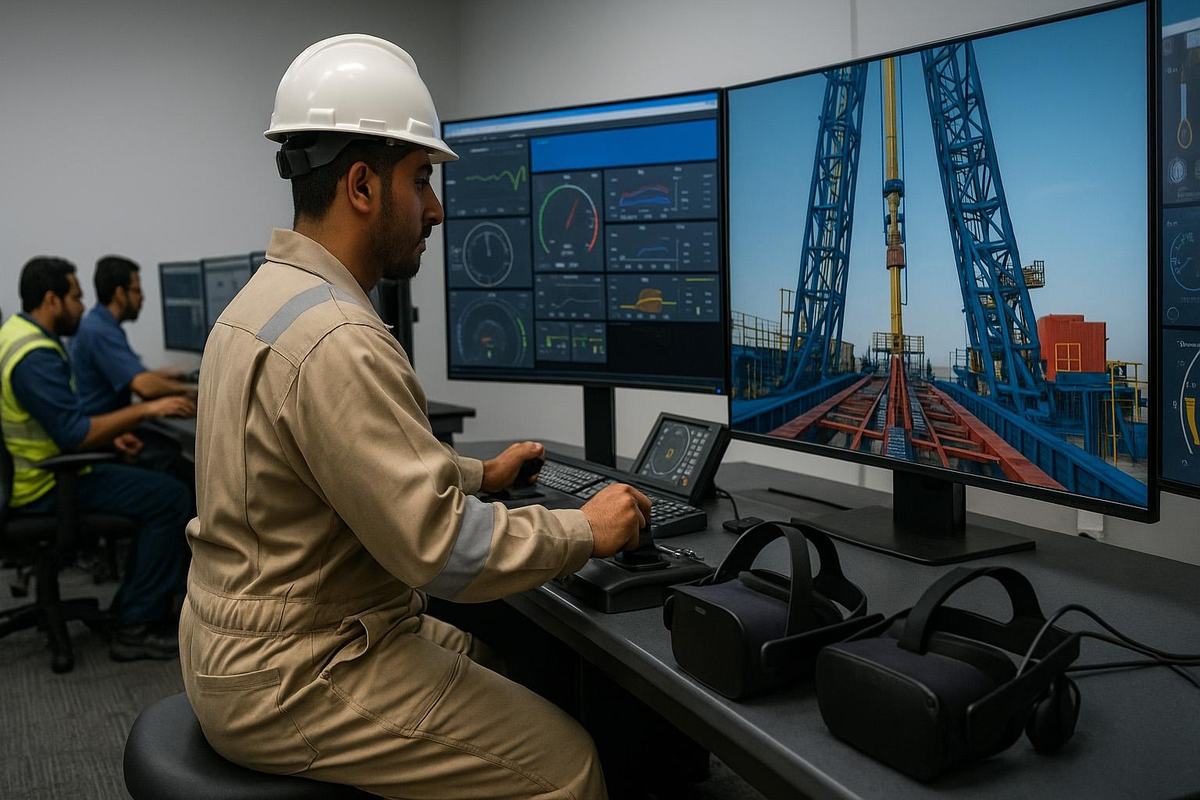
When Abdul Ilah signed the contract with one of the major drilling companies after graduating from the “Saudi Drilling Academy,” he thought it was the academic finish line. Exactly three years later, he received an internal email invitation for a mandatory return to the academy for a 12-week “Continuous Learning” program.
The question that arises is: Why does a productive employee return to the classroom while the company is experiencing a shortage of competencies?
The Engineering of the “Continuous Learning” Program: A Semi-Chlorine Cycle
- Time Threshold: Every 36 months, the employee is called for a course designed according to career ladder upgrades (Driller → Operator → Field Supervisor).
- Content Equation: 60% new skills (applied artificial intelligence, remote monitoring systems), 25% updating safety standards, 15% reviewing actual errors in the fields.
- Financial Arm: “Tamkeen” funds 50% of the cost if the employee passes the final exam successfully, and the company pays the remaining half.
The Similarity to a Semi-Chlorine Cycle in Chemistry: The raw material (the employee) undergoes regular re-refining to maintain the purity of competency.
Do the Numbers Justify the Employee’s Return to “Class”?
Indicator | Before the Continuous Learning System | After the First Course (36 Months)
Accident Rate per Million Hours | 1.6 | 0.9
Average Unplanned Downtime for Drill (Hours/Month) | 14 | 6
Corrective Maintenance Cost (Annually) | 2.4 Million ﷼ | 1.1 Million ﷼
Internal Promotion Ratio vs. External Recruitment | 48% | 73%
- 44% reduction in accidents indicates that updating technical skills is coupled with a safety mindset update.
- More than half decline in unplanned downtime means a higher ability to leverage capital for drilling rigs.
- Jump in internal promotions reduces replacement time and the cost of “culture shock” for new workers.
The Technical Dimension: How are “Self-Updating” Curricula Designed?
- Field Data Warehouse: Captures 8 gigabytes/day from drilling sensors, which are converted into realistic training scenarios after cleansing.
- Content Recommendation System analyzes each employee’s error log and rearranges educational units according to their individual gaps.
- Programmable Simulation: Development teams can introduce “next-day” risks within 72 hours of their emergence in the field.
The Result: The curriculum grows organically like an operating system that receives periodic security updates.
The Economic Aspect: Regular Investment with No Excess Cost
- ROI = 2.8: For every riyal invested in continuous learning, 2.8 riyals are generated in savings from reduced breakdowns and accidents, according to the financial engineering department's calculations at the academy.
- The Law of Diminishing Returns has not yet appeared: Because technology, and not human repetition, is what renews, making every course carry radically different content.
- Scenario Without Continuous Learning: By the fifth year, half of what the technician learned in the foundational course becomes outdated, according to the Academy's Technology Obsolescence Index.
Insights Transferable to Other Sectors
Sector | The Critical “Update Moment” | Feedback Data Source
Renewable Energy | Every 24 months (Turbine Software Update) | Farm Control Center
Home Healthcare | Every 18 months (Remote Treatment Protocols) | Virtual Health Platform
Cybersecurity | Every 6 months (Zero Threats) | National CERT

Comments (3)
No comments yet. Be the first to comment!