
Introduction
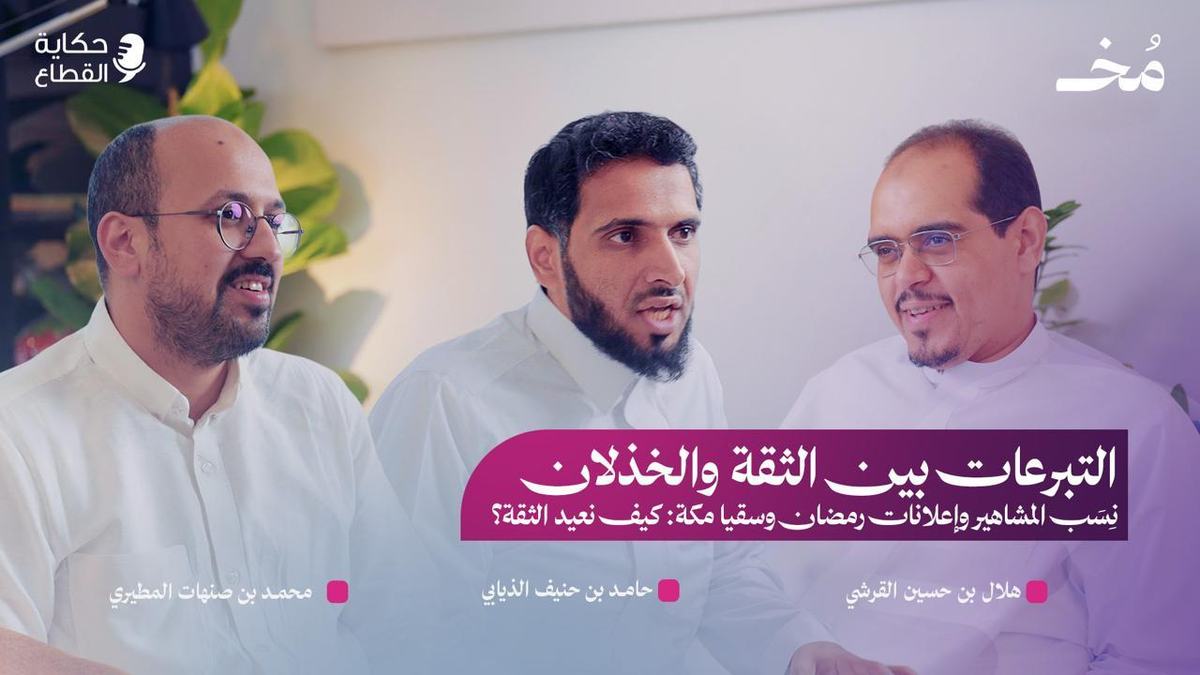
The fourth episode of the Sector Story podcast addresses the issue of donations in Saudi Arabia as a socio-economic system that goes beyond the act of giving itself to building a long-term relationship between the donor and the organization. The discussion presents three central theses:
- The issue is not finding a donor but sustaining them due to poor communication after the first experience.
- Documented storytelling is the driver of emotion and trust before and after the donation.
- Applying commercial marketing tools to non-profit work without ethical/professional alignment yields off-putting seasonal advertising and distorts the concept of "impact".
What did the episode convincingly present?
- Shifting the focus from 'raising funds' to 'building a donor base': the episode highlighted the necessity of measuring success by retention and repeat indicators, rather than settling for seasonal income volume. This is a necessary conceptual shift.
- Valuing post-donation: Practical examples (handwritten letters, gifts, evoking tangible impact) show how a donor transforms from a transient transaction to "a member of a story".
- Storytelling unit: A recommendation to establish an independent unit within the association to transform numbers into human stories that preserve privacy; this is a foundational recommendation and not a mere media embellishment.
- Criticism of seasonal charity advertisements: The episode revealed recurring shortcomings in Ramadan advertisements (rhetorical discourse, cliché repetition, mixing the religious with the commercial, exaggerating promises) and its impact on the sector's reputation and public trust.
- Operational transparency: An acknowledgment of the necessity to disclose marketing and operational expenses and propose alternative funding models (funding costs from operational donors outside the donation amount).
Where could the episode have been stronger?
- Managing the opening and pacing: A lengthy introduction filled with jokes and side conversations squandered the valuable first minutes; the pace could have been adjusted with a clear thesis statement and "oral executive summary" in the first three minutes.
- Generalizing vs. scrutinizing: Sometimes judgments are made on "associations" or "advertisements" in broad terms; it would have been beneficial to underpin the criticism with frameworks and standards (for example: disclosure governance standards, conflict of interest policies, proposed upper limits for relative marketing expenses).
- Mixing the witness and the evidence: Oral storytelling is rich, but it always needs to standardize terminology and connect it to concise numerical examples to solidify meaning for non-specialists.
- Dismantling the issue of "Mecca's water supply" into environmental-organizational-economic dimensions: Important questions were raised, but it is necessary to distinguish between what is seasonal behavioral, what is economic feasibility for endowments, and what is environmental impact of waste, with alternatives (sustainable structure solutions, controlled pricing, geographical priorities).
Knowledge gaps that can be filled
- Intentional approach: How can marketing messages be built to consider public purposes (education, health, civil infrastructure) without complete dependence on the "individual cases" narrative?
- Designing the donor experience: The need for a clear pathway from the moment of recognition to the moment of "return impact" (Feedback Loop) within 24 hours, 30 days, and 90 days.
- Governance of "percentages": Setting an ethical-professional framework for charitable advertising: prior disclosure of marketing costs, policy on using influencers, and preventing conflicts of interest, with understandable disclosure language for the public.
Editorial recommendations for upcoming episodes
- Thesis summary in minute 0:30–1:00: What is the problem? Why does it matter? What will we discuss?
- Concept bag: Short fixed definitions (general/restricted/in-kind donation – operations – impact – CAC – LTV).
- Data section: One documented number in each episode on which discussion is built (without mentioning specific platforms).
- One complete narrative: A case presented narratively according to privacy standards and beneficiary consent.
- Practical conclusion: A checklist of 5 items "to start with tomorrow" for resource development managers.
Practical recommendations for the sector (executive summary)
- Treat the donor as a relationship customer:
- Immediate thank-you message + impact update within 30 days + personal invitation for non-financial participation (visit/event/survey).
- Brief transparency policy:
- Statement of operating/marketing expenses in simplified language on project pages.
- Don’t measure success by the amount alone:
- Adopt indicators: annual retention rate, average repeat donation, cost of acquiring a donor, percentage of opening post-donation messages.
- An advertisement that deserves public trust:
- Tell stories, don’t just throw slogans. Give the audience a "human reason" and a "clear pathway to impact".
- Alternatives to seasonal "water supply":
- Invest in sustainable infrastructure (coolers, maintenance, waste management), fair geographical priorities, and a declared environmental-economic approach.
- Aligning commercial marketing:
- Take from its technical tools (targeting, A/B testing, page optimization), and leave the logic of "trends" and "short-term emotional pressure".
Finally:
The episode makes a good presentation of the essential question: How do we shift from a mentality of “collecting donations” to a philosophy of “building donors”? The path starts with a sincere story, a communication that respects the audience's intelligence, and transparency that reassures the heart before the wallet. What the sector needs today is not more knocking on doors, but more visible impact and a language that preserves the dignity of the cause and establishes the argument for the practice.
About the episode presenters:
- Hilal bin Hussain Al-Qurashi — Editor-in-Chief of "The Third Bank | The Knowledge Enrichment Encyclopedia for the Non-Profit Sector".
- Mohammed bin Sanhat Al-Mutairi — CEO of "Azar" for Business Development and Growth Solutions.
- Hamid bin Haneef Al-Dhiyabi — Consultant in marketing and financial sustainability for non-profit organizations.

Comments (3)
No comments yet. Be the first to comment!