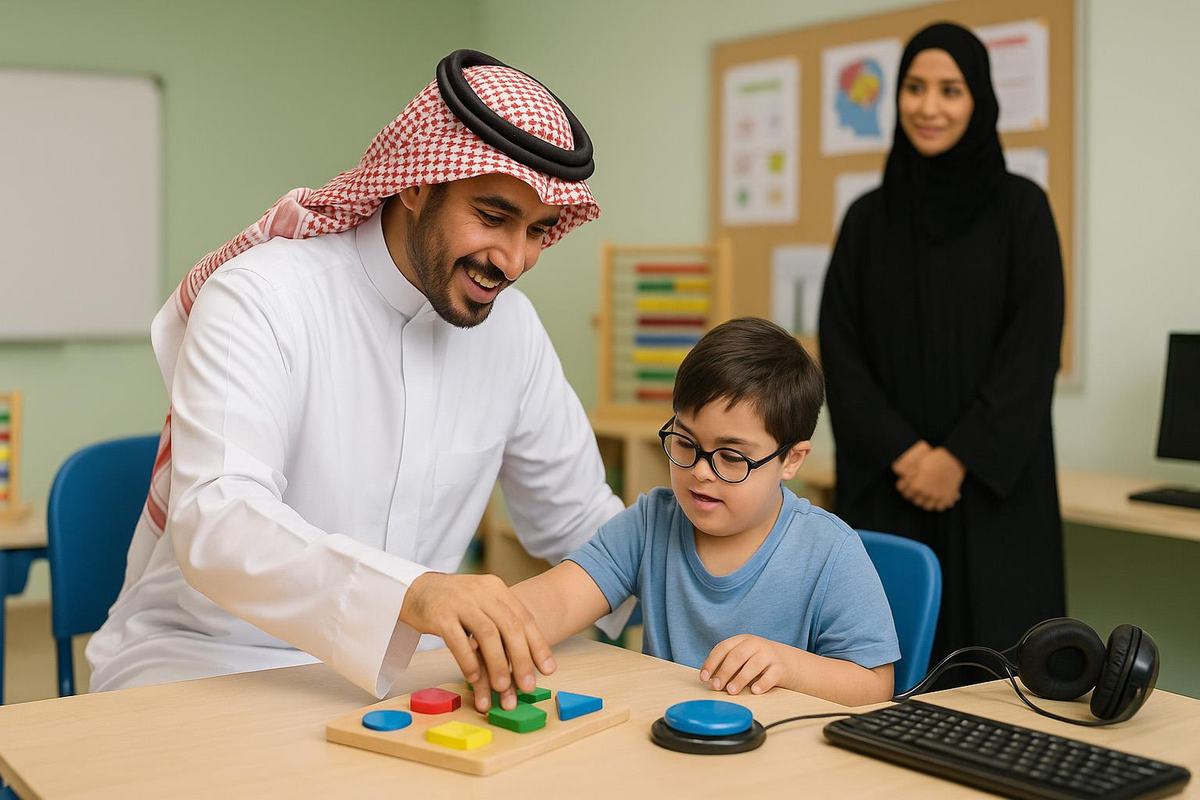

A Practical Guide Derived Entirely from the Experiences of "Taiba City for Special Education" and "Qudrat Schools"
During the 2025 Non-Profit Education and Training Forum, the model of "Taiba City" (Medina) was presented as a successful alliance that included the Ministry of Education, the health cluster, the Endowments Authority, and local associations. Following that, the Rehabilitation Association of Unaizah presented the experience of "Qudrat Schools" as a specialized school with light governance and limited costs. In the following pages, we will transform the shared lessons into a roadmap of seven steps that associations can adapt in any region of the Kingdom.
Step 1 – Diagnosis and Governance
Diagnosis Element | Practical Tools | Example from Taiba/Qudrat
Assessing Demand | - Survey with education offices - Health cluster database | A deficit was discovered to serve 5,000 students in Medina
Targeted Disability Categories | - Special education classifications booklet - Development and Behavior teams | Taiba targeted intellectual, hearing, and visual disabilities; Qudrat started with intellectual disabilities and autism
Governance Board | Decision from the Emirate of the region or a tripartite memorandum of understanding | A board chaired by the deputy emir, including education, health, and associations
Executive Advice: Do not move to step two before obtaining the "request number" from the three entities; it is the basis for budgeting and design.
Step 2 – Selecting Strategic Partners
Partner Category | Why is it Indispensable? | Practical Example
Local University | Research, field training, academic supervision | College of Education and Medicine at Taiba University
Health Cluster | Medical diagnosis, parallel treatment plan | Development and Behavior Clinic within Taiba campus
Endowment or CSR Fund | Building and equipping costs | Endowments Authority + Local Unaizah Endowments
Vocational Training Entity | Secondary pathway leading to employment | Technical College in Medina (Light Electronics Certificate)
Step 3 – Funding: A Combination of Grants + Operations
Item | Funding Source | Risk Management Notes
Building Construction | Endowment grant or CSR | Educational supervision condition to comply with school standards
Equipment | Joint funding package (Endowment + Ministry of Education) | Central purchase to reduce costs by 15%
Operating Costs | Operational contract with education (salaries) + paid clinics | Self-generated income reaches 25% of the budget after 3 years
Emergency Fund | 5 – 7% of the total annual budget | Requirement from the Endowments Authority to disburse the second payment
Step 4 – Designing Educational and Rehabilitation Programs
Stage | Curriculum Focus Areas | Innovations Tested
Early Childhood | Language – Movement – Speech – Sensory Intervention | Sensory Room
Primary | Cognitive curriculum + Life skills | “Training Store” to buy and sell simple products
Intermediate/Secondary | Vocational track (3D printing – Light Electricity) | Partnership with a local factory for practical training
Family Programs | Family counseling – Behavioral management at home | Mobile app linking the family with the teacher
Step 5 – Performance Measurement Board
- Parent Satisfaction Survey (Threshold Indicator: 80%).
- Rate of Individual Education Plan (IEP) Achievement for each student (Target ≥ 70%).
- External Inclusion Indicator: Number of students transitioned to mainstream education annually.
- Quarterly Financial Reports published on the association's website.
- Annual Visit for “Masar” Program for quality accreditation and classification.
Step 6 – Typical Timeline (24 Months)
Month | Task | Leading Entity
1 – 3 | Market Study and Diagnosis | Joint Education/Health/Association Team
4 – 6 | “One-Pager” Document + Emirate Approval | Association
7 – 12 | Design Architectural Plan – Secure Funding | Endowments Authority + Education
13 – 18 | Build and Equip Laboratories | Contractor + Educational Supervisor
19 – 22 | Recruit Staff – Pilot Curriculum | School Management
23 – 24 | Official Opening – Performance Board Operation | Partners Board
Step 7 – Smart Expansion
- Central Option: Taiba Model (Integrated campus serving provinces through mobile clinics).
- Distributed Option: Qudrat Model (One building + attached units within three existing schools).
- Expansion Condition: Achieving a ⭐⭐⭐ rating in “Masar” and financial sustainability for one year.
Executive Summary
- Joint Diagnosis is the cornerstone; do not start without a validated number.
- Diverse Funding reduces risks: Construction grant + government operation + self-income.
- Live Performance Board transforms the school from a “Care Center” to a “Platform for Empowerment and Education.”
- Lessons are replicable if adhered to the seven steps and their sequence.
Open your school for people with disabilities with a clear plan, and you will reap an educational and community impact measurable in numbers, not slogans.

Comments (3)
No comments yet. Be the first to comment!