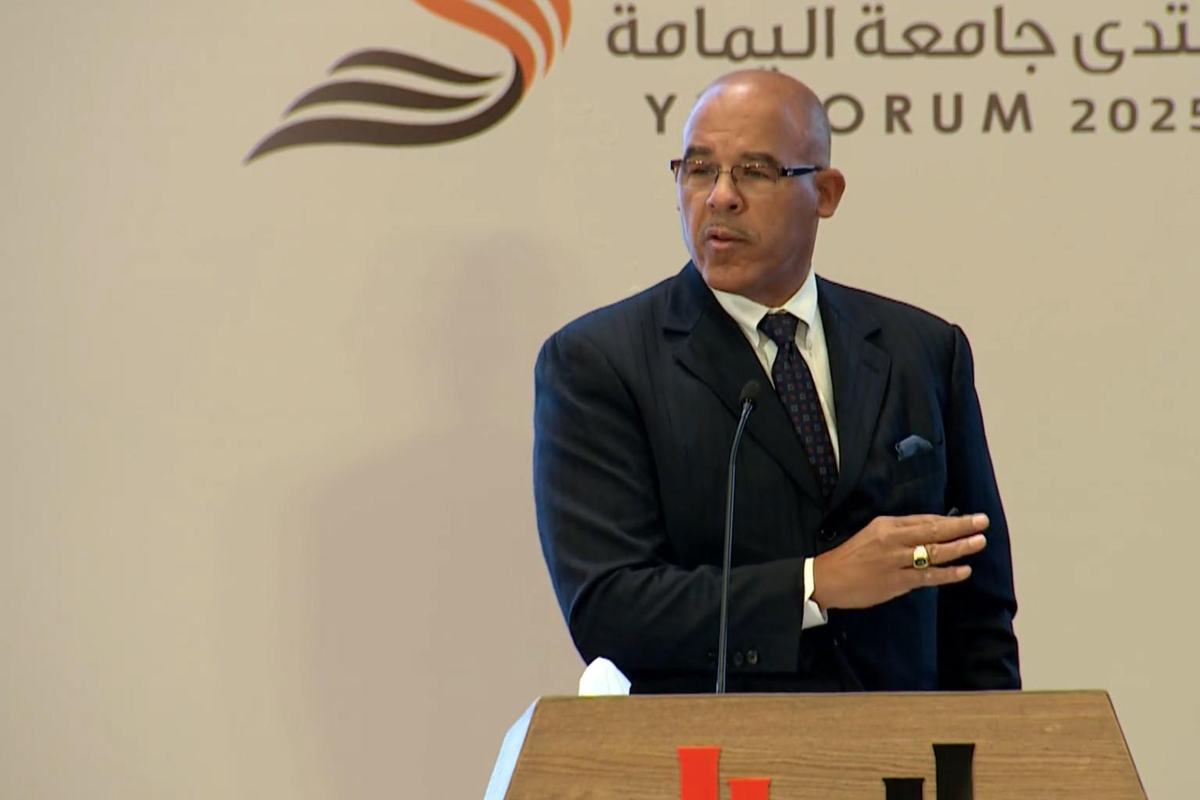

Under the slogan 'Educational Endowments and Achieving the Goals of Vision 2030 in the Education Sector', one of the most important sessions at the forum was the speech by the international speaker Mr. James Moore, CEO of the University of Illinois Foundation, moderated by the calm and confident academic Dr. Hessa bint Abdullah Al-Salama, Vice President of the University for Academic Affairs.
On the morning of Monday, November 17, 2025, corresponding to the 26th of Jumada Al-Awwal 1447 AH, the Sheikh Mohammed bin Ibrahim Al-Khudair Hall at Al-Yamamah University in Riyadh resembled a stage for a new relationship between the university and the endowment.
This report strives to document that session as a knowledge document for the third bank, capturing the deep lessons for Saudi universities and the educational non-profit sector beyond the numbers and slides.
The Opening Scene… When Riyadh Meets Illinois
James Moore entered the hall with decades of experience managing one of the largest university endowments in the United States. However, what caught attention from the very first minutes was not the scale of the numbers he spoke about, but the way he connected student life and the movement of investment assets.
Dr. Hessa Al-Salama introduced Moore to the audience, outlining his role as the head of an independent legal entity that manages the University of Illinois endowment for the benefit of the university, then left the platform for him to transport the forum – for a few minutes – from Riyadh to the heart of the American experience in educational endowments.
From One Dollar to Billions… The Story of the University Endowment
How can small donations transform into endowments worth billions of dollars?
Moore started with the question that occupies any emerging university in the world of endowments:
Gifts come from individuals, alumni, and families, and are collected in endowment funds that are carefully invested over long periods. Over time, thanks to investment performance and successive donations, these funds transform into massive assets that fund scholarships, scientific research, and innovation programs.
He explained that every university endowment in his country literally starts with one dollar.
Moore emphasized that the source of this money is fundamentally human:
'Individuals invest in individuals. The donor does not place their money in a building of stone, but in people who lead the university and can solve a problem that occupies them.'
There is an upward curve of giving over decades, with hundreds of billions of dollars annually going to various sectors, leading with religion and education. However, the focus was not on the size of the pie as much as it was on the part that goes to education, and how it contributes to building a strong university endowment system.
He then descriptively reviewed the map of charitable giving in the United States:
Diversification of Assets… A Farm Graduating 955 Students
In a striking dramatic moment, Moore transitioned from the world of graphs to an agricultural field.
A piece of land measuring 656 acres was the starting point for nearly 7000 acres of farmland now managed by the foundation as part of the endowment portfolio.
He presented an image of the first farm that was endowed for the University of Illinois in 1954:
This farm alone:
- Funded the education of more than 955 students to date.
- Achieved returns exceeding 600,000 dollars.
- And is still managed and producing to fund the future.
The landowner – as Moore narrates – was concerned that students should receive an affordable education in Illinois. He was not thinking about a 'farming project' but rather about a permanent educational bridge. What the foundation did was turn this desire into a sustainable investment model: the land is cultivated, reinvested, and each year the harvest goes to new students.
In the hall, this example transcended the borders of Illinois; it opens up a wide door for Saudi universities to think of educational endowments as productive assets: farms, real estate, and professionally managed business projects; not merely inactive deposits in bank accounts.
Endowments Are Not Just Money… They Are a Complex Governance System
After grabbing the audience's attention with the story of the farm, Moore returned to what he called 'the art of post-donation'.
He explained that the real challenge begins after accepting the gift; managing endowments requires a comprehensive organizational structure:
A well-studied minimum for the endowment
- At the University of Illinois Foundation, the minimum to establish a new endowment is 25,000 dollars.
- This is not a barrier for donors but an acknowledgment that managing the endowment has administrative, accounting, and legal costs that must be covered.
Managing thousands of endowment accounts
- The foundation manages about 7000 endowment accounts, each with a specific purpose and independent documentation.
- This means that the endowment is not a 'single vessel'; rather it is a complex network of directed funds that require precise systems for monitoring and reporting.
Governance and Policies
- Establishing clear donor agreement documents: What does the donor want? How are the returns to be used? What are the limits on modifying objectives in the future?
- Forming boards of trustees and investment committees that make decisions away from subjectivity, and with a sense of responsibility towards the university and the donors.
- Establishing spending policies that balance between preserving capital and funding the present; because this money – as he said – 'is eternal dollars'.
Documentation and compliance with the donor's intent
- Accepting the gift is one step; documenting it and monitoring the execution of the donor's condition is a complete path.
- Accurate records, information systems, and periodic reports ensure that the institution does not deviate from the purpose for which the endowment was established.
It is not enough to announce an endowment fund; we must invest in the administrative structure that protects it.
In those moments, James Moore was not merely describing a distant university experience, but he was drawing – without stating it directly – A roadmap for Saudi universities that are beginning today to build their educational endowments:
Questions from Riyadh… and the Answer from a Global Experience
After the presentation ended, Dr. Hessa Al-Salama opened the floor for questions from the audience, leading to discussions that ventured into legal and cross-border areas.
1. Tax Question
Are university endowments in the United States treated like commercial companies?
One audience member asked Moore about taxes:
He replied that his foundation is registered as a non-profit charitable organization, and thus it is exempt from income tax on the endowment's assets and returns, as long as they are allocated for educational and charitable purposes. However:
- If the foundation owns a property that is not used for educational purposes, it is obligated to pay property taxes on it like others.
- The exemption is not absolute but linked to achieving the declared educational purpose.
This balance between exemption and accountability provides a model that other legal environments – including the Saudi environment – can benefit from in designing systems that regulate the relationship between the state and educational endowments.
2. Cross-Border Endowment Question
Another question came from a faculty member on how to establish educational endowments that accept international donations amidst varying legal systems from country to country.
Moore responded that the University of Illinois faced this issue about ten years ago, creating in the UK a registered charitable entity (dual qualified), allowing donors in several European countries to:
- donate to the university through this entity.
- obtain in their countries the tax benefits typically available for local donations.
- These donations are then transferred – through clear regulatory mechanisms – to the university foundation in the United States.
In this way, the university endowment transitioned from a local project to a global funding network, while maintaining compliance with laws in each donor's country.
Closing Messages for Saudi Universities and the Non-Profit Sector
Through this session, a set of practical messages can be summarized that concern Saudi universities and their emerging endowments:
Thinking of endowments as living assets
The endowed farm in Illinois serves as a reminder that we can have educational endowments based on agricultural, real estate, or industrial assets managed professionally, funding education for decades.
Investing in governance before gathering large amounts
A sound administrative structure and strong accounting and legal systems are prerequisites for sustaining trust, before they become an organizational luxury.
A long-term bet on individual trust
Individuals – not just companies – are the backbone of educational endowments. Building a deep relationship with alumni and potential donors is part of the university's daily work.
Anticipating the international dimensions of educational endowments
From the outset, avenues for donations from communities and those interested in Saudi education outside the kingdom can be considered through well-planned partnerships and intermediary bodies.
A Word of Appreciation for Al-Yamamah University
By hosting a figure like James Moore and allowing space for open dialogue with the audience, Al-Yamamah University proves that it does not treat the topic of educational endowments merely as a 'funding issue', but rather as a matter of knowledge and capacity building for all Saudi universities.
At the end of the session, there was an official expression of gratitude from the session management, but what can be noted in terms of knowledge goes beyond mere protocol courtesy.
This report records explicit thanks to the university – both management and organization – for opening a practical window onto one of the deepest global experiences in university endowments, and for the role it plays in linking Vision 2030 with financial sustainability tools in higher education.
At its core, it was contemplating the features of an upcoming Saudi model for educational endowments, rooted in its land, investing in its knowledge, and exporting its impact to the world.
Through this session, Riyadh was not merely listening to the Illinois experience;

Comments (3)
No comments yet. Be the first to comment!