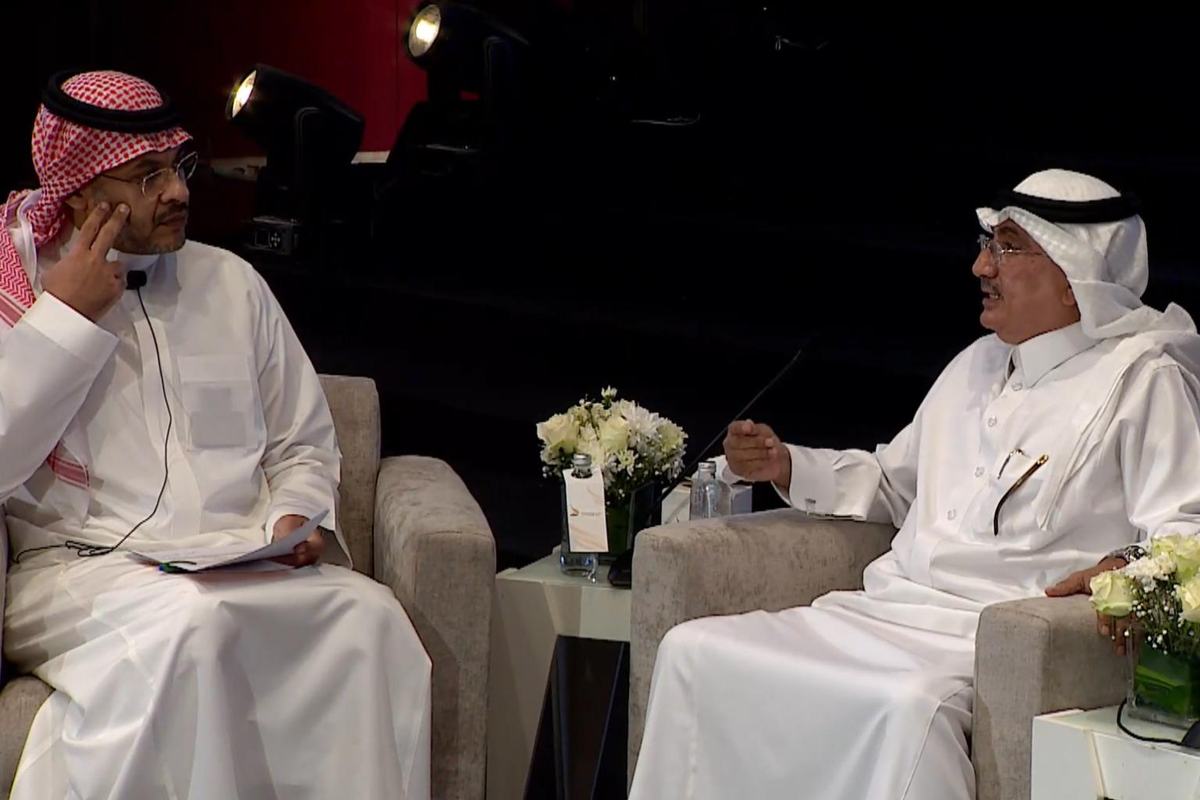

In a fully attended hall at Al-Yamamah University in Riyadh, everything indicated that we were in front of a different kind of forum; a forum that puts educational endowments under scrutiny, not merely as a source of funding, but as a strategic tool for sustainability and supporting development.
The session was introduced by the media presenter Waheeb Al-Dakheel – Public Relations Manager at MBC Media Solutions – with a calm yet confident voice, welcoming the guests and attendees, and paving the way for a discussion panel titled:
“Educational Endowments and Their Role in Achieving Sustainability and Supporting Development”.
On the platform sat four names representing the convergence of practical experience with strategic vision:
- Professor Khalid bin Mohammed Al-Khudir – Supervisor of the Sheikh Mohammed bin Ibrahim Al-Khudir Endowments.
- Dr. Khalid bin Suleiman Al-Rajhi – Chairman of the Board of Trustees at Al-Rajhi Humanitarian Foundation.
- Engineer Mishari bin Fahd Al-Juwaira – General Manager of Social Responsibility and Voluntary Work at the Ministry of Education.
- Dr. Saleh bin Abdullah Al-Shamarani – Executive Director of the Hissa Al-Qubaisi Program for Scientific Excellence.
While Waheeb Al-Dakheel presented a general framework for the relationship between endowment, education, and development, one of the most prominent points in this session was the intervention of Professor Khalid bin Mohammed Al-Khudir, which shifted from narrating a personal experience to a practical lesson in the engineering of educational endowments.
When Experience Leads the Path of the Endowment
Khalid Al-Khudir began his talk from a clear point:
The Al-Khudir family did not choose education by chance, nor did they turn to educational endowments as a “trend” in charitable work; rather, this direction came after decades of work in education - both profitably and non-profitably - exceeding eighty years.
This long experience made the decision to allocate the endowment for education a natural and logical one:
“We endow in the field we understand, and we invest in the area we know the details of.”
This simple principle embodies one of the most important global practices in endowment management:
Aligning the endowment’s field with the endower's expertise, so that the endowment is not just funding, but a qualitative addition in program design, understanding needs, and measuring impact.
Public Education… “The Underrated” on the Map of Endowments
With a calm yet decisive tone, Al-Khudir drew attention to a fundamental gap:
Most educational endowments in the past fifty years have focused on:
- University endowments, associated with research and grants.
- Or religious schools, Quran memorization circles, and mosques.
Meanwhile, public education – the schools for boys and girls spread across cities, provinces, and villages – has not received sufficient endowment support, despite representing the foundation through which every young man and woman in the Kingdom passes.
With this direct description, Al-Khudir provided a diagnosis similar to what research reports do:
Identifying the gap first, then building an intervention model to address it.
The First Pathway – The School Environment… An Investment in the Foundation
In a language close to developmental discourse, Al-Khudir pointed out that the education budget in the Kingdom exceeds 200 billion riyals annually, yet schools still need:
- Appropriate and stimulating buildings.
- Periodic maintenance to maintain the quality of the educational environment.
- Modern technical and educational equipment.
- Comfortable and functional furniture.
- Supporting educational programs.
Here, the Mohammad Al-Khudir Endowments chose to intervene in one of the most impactful yet least visible points in the media:
Supporting the school environment in public education.
For over 25 continuous years, the endowments have implemented a long-term program that includes:
- Maintenance of several public schools.
- Equipping them with technical equipment and laboratories.
- Supporting furniture and basic facilities.
- Contributing to financing educational programs within these schools.
This type of intervention does not produce a “beautiful image” for social media, but quietly makes a difference in the experiences of hundreds, if not thousands of students, and creates a learning environment that respects both the student and the teacher.
The Second Pathway – Talent… A Small School with a Global Dream
If the school environment is the foundation, then talent is the fuel that transforms education from a process of rote learning to a project of revival.
From here, Al-Khudir moved to discuss one of the most inspiring experiences in educational endowments:
An exemplary school for talented students in the province of Riyadh Al-Khubar, west of Qassim.
The data he mentioned paints a completely different picture from the stereotypical image of schools in small provinces:
- An exemplary school for talented boys and girls.
- Number of students: about 120 boys and 120 girls.
- Their selection is done carefully through an official partnership with the Mawhiba Foundation.
- High educational possibilities and facilities.
- An educational model that rivals – as he described – what can be seen in schools in the Silicon Valley area in the United States.
The value of this experience lies not only in the “school” itself but in the message it carries:
That quality education is not exclusive to capitals and major cities, and that a small province can embrace a globally standard educational model if a serious endowment vision and conscious partnerships exist.
The Endowment is a Partner, Not a Substitute… Engineering the Relationship with the State
One of the notable points in Al-Khudir's discourse was his affirmation that the endowment:
- Is not a substitute for the state,
- Nor a competitor to it,
- But a partner that fills gaps, tests new models, and supports implementation in the field.
The Mohammed Al-Khudir Endowments work in:
- Partnership with the Ministry of Education.
- Collaboration with the Mawhiba Foundation.
- Coordination with other educational entities.
This approach is consistent with best global practices adopted by major universities and think tanks:
The government sector sets the framework, while the endowment and community sector adds flexibility, innovation, and speed.
Analytical Reading – Why Does the Al-Khudir Experience Seem Different?
From an analytical perspective, the uniqueness of the Mohammed Al-Khudir Endowments experience can be summarized in several key points:
Specialization Based on Experience
The endowment here does not scatter its efforts across dozens of fields but focuses on education; specifically public education and talent, based on the family's long history in this sector.
Selecting a Real Gap, Not a Comfortable Zone
Instead of increasing university endowments, the experience directed itself to where the need is greater:
Public education schools in various regions, and talented individuals in a small province.
Sustainable Timeliness of Programs
A program that lasts over 25 years to support schools is not a “seasonal initiative,” but a sustainable policy, allowing for the accumulation of impact and deepening results.
Decentralized Educational Excellence
The Riyadh Al-Khubar school is not just a school; it is a message that the future can start from the peripheries, not just from the center.
Alliance with Talent as a Strategic Choice
Linking the endowment with the talent line aligns with the trends of Saudi Vision 2030 in investing in human capital, transforming the endowment from “assistance” to investment in minds.
From the Forum to the National Map of Educational Endowments
The session hosted by Al-Yamamah University was not just a passing discussion.
In reality, it resembled an open strategic thinking workshop, involving:
- The voice of family educational endowment (Al-Khudir Endowments).
- The voice of major humanitarian institutions (Al-Rajhi Humanitarian Foundation).
- The voice of the organizing and legislative governmental entity (Ministry of Education).
- The voice of quality programs in scientific excellence (Al-Qubaisi Program).
In this context, Khalid Al-Khudir's intervention formed a practical model that many upcoming policies and initiatives in the field of educational endowments can be built upon.
A Model Worth Teaching
From Riyadh Al-Khubar to Silicon Valley, Al-Khudir was not marketing a family achievement as much as he was presenting a clear equation:
- If there is a Deep-rooted Experience in Education,
- Along with a Conscious Endowment Vision,
- And Smart Government and Community Partnerships,
Then the output is not just a school or a maintenance program, but a Quiet Transformation in the Future of Public Education that reflects on sustainability and development for decades to come.
This experience, as it emerged from the platform of Al-Yamamah University, is not just a success story;
But raw material that is suitable to be turned into:
- A case study in colleges of management and endowments.
- A model to be emulated in educational endowments across the Kingdom.
And a practical inspiration for anyone who asks:
How can the endowment be more than just a “building”, but become an “idea that changes the future of a generation”?

Comments (2)
No comments yet. Be the first to comment!